Picture the American plate as 100 calories. Fifty-five of them now come from ultra-processed foods, a category of industrial formulations that supplied a small corner of the diet two generations ago and makes up the majority of it today. For children the figure is higher still, around 62 calories in every 100. No other country eats this way at this scale, and the shift has been fast enough to measure inside a single lifetime.
This guide is about what that shift is doing to us. The evidence is stronger and more alarming than most balanced explainers let on, and it holds up precisely because it does not need exaggeration. The harm shows in a controlled feeding trial, in nearly ten million people across dozens of studies, and in the disease curves of an entire population. Here is what the research actually says, and what to do with it.
The evidence in brief
- Ultra-processed foods now supply about 55% of the calories Americans eat (roughly 62% for children), the highest share of any country measured.
- They are not merely junk food. The NOVA system defines them as industrial formulations built from refined substances and additives you would not keep in a home kitchen, which makes them distinct from ordinary processed foods like cheese, canned beans, or fresh bread.
- The strongest evidence is causal. In a tightly controlled NIH trial, people ate about 500 extra calories a day on an ultra-processed diet and gained weight, even though the meals were matched to the unprocessed diet for calories offered, sugar, fat, fiber, and salt.
- A 2024 review of nearly 10 million people graded the evidence linking higher intake to cardiovascular and all-cause mortality, type 2 diabetes, and common mental disorders as convincing or highly suggestive.
- The harm tracks with the dose. Each 10% rise in the share of ultra-processed food in the diet is associated with roughly 10% higher all-cause mortality risk.
- Not every product is equal, and the goal is fewer, not zero. Sugary drinks, processed meats, and refined snacks carry the clearest risk; a plain whole-grain bread or tub of yogurt does not belong in the same sentence.
What "ultra-processed" actually means
The phrase gets thrown at anything that comes in a package, which is exactly the confusion the food industry benefits from. The useful definition comes from NOVA, a system built by Brazilian researcher Carlos Monteiro and his team that sorts food not by nutrients but by how much industrial processing it has been through. It splits everything into four groups.
| NOVA group | What it is | Examples |
|---|---|---|
| 1. Unprocessed or minimally processed Eat freely | Whole foods, or whole foods altered only by drying, freezing, or grinding. | Fresh and frozen fruit and vegetables, plain grains, eggs, milk, meat, fish, beans, plain nuts. |
| 2. Processed culinary ingredients Use to cook | Substances pressed or refined from group 1, used to season and cook. | Olive oil, butter, sugar, salt, honey, vinegar. |
| 3. Processed foods Fine in context | Group 1 foods preserved with group 2 ingredients, still recognizable as food. | Canned beans and vegetables, cheese, salted nuts, canned fish, fresh-baked bread, smoked or cured meat. |
| 4. Ultra-processed The problem | Industrial formulations made mostly from refined extracts and additives, with little or no intact whole food. | Soft drinks, packaged snacks and sweets, instant noodles, reconstituted meat products, most mass-market breads and breakfast cereals, ready meals. |
The line that matters runs between group 3 and group 4, and it is the line most people get wrong. A block of cheddar, a can of chickpeas, and a loaf from the bakery are all processed, and all perfectly good food. Ultra-processed products are different in kind. They are assembled from cheap refined ingredients such as maltodextrin, modified starch, protein isolates, and hydrogenated or interesterified oils, then made palatable with colors, flavors, emulsifiers, and non-sugar sweeteners. A quick tell: if the ingredient list contains things you would never find in a domestic kitchen, you are usually holding group 4. That distinction is the whole game, because the science below is about group 4 specifically, not about the broad, harmless act of cooking or preserving food.
The experiment that turned correlation into cause
Most of what we know about ultra-processed food comes from observational studies, which can show a link but never prove that the food itself is the culprit. One study is the exception, and it is the reason this topic moved from suspicion to evidence. In 2019, Kevin Hall's lab at the National Institutes of Health ran a randomized controlled trial that few people thought was even possible.
Twenty adults lived on a hospital metabolic ward for a month. For two weeks they ate an ultra-processed diet, and for two weeks an unprocessed one, in random order. The catch that makes the result so striking: the two diets were carefully matched for the calories offered, plus sugar, fat, salt, fiber, and overall macronutrients. Participants could eat as much or as little as they wanted at every meal. On paper the diets were nutritionally equivalent.
They did not eat equivalently. On the ultra-processed diet people consumed about 500 extra calories a day, and over the two weeks they gained roughly two pounds. On the unprocessed diet, eating the same nutrients on paper, they lost about two pounds. Nobody was told to restrict or indulge; the food environment alone moved them. Ultra-processed meals were eaten faster and were softer and more energy-dense, so more calories went down before the body's fullness signals could catch up. For the first time, a controlled experiment showed the format of the food, beyond its sugar or fat content, drives overeating. Everything that follows in the population data has this trial sitting underneath it.
What ultra-processed foods do across the body
The largest synthesis to date is a 2024 umbrella review in The BMJ, which pooled 14 meta-analyses covering 45 separate analyses and almost 10 million people. Its value is not a single scary headline but a graded verdict: the authors rated how trustworthy the evidence is for each outcome, from "convincing" down to "weak." Keeping those grades intact is what separates honest reporting from a scare. Here is the picture, strongest evidence first.
| Outcome | Association with higher intake | Evidence grade |
|---|---|---|
| Cardiovascular disease death | About 50% higher risk | Convincing |
| Type 2 diabetes | About 12% higher risk per increment of intake | Convincing |
| Anxiety and common mental disorders | Roughly 50% higher likelihood | Convincing |
| All-cause (any) death | About 21% higher risk | Highly suggestive |
| Obesity | About 55% higher likelihood | Highly suggestive |
| Depression (new onset) | About 22% higher risk | Highly suggestive |
| Poor sleep, wheezing | About 40% higher likelihood each | Highly suggestive |
Two honest caveats belong right next to that table. First, most of these findings come from observational studies, so residual confounding cannot be ruled out: people who eat the most ultra-processed food also tend to smoke more, move less, and earn less, and statistics can only partly separate those threads. Second, "convincing" in this review still rests on low-certainty underlying data for some outcomes. What makes the verdict hard to dismiss is the convergence. The metabolic-ward trial supplies the mechanism, the dose-response pattern fits, and dozens of independent cohorts on several continents point the same direction. When the experiment, the dose curve, and the population data agree, coincidence becomes a strained explanation.
That dose-response point deserves its own line, because it is some of the most persuasive evidence in the file. A pooled analysis of 18 cohorts and more than a million people found that for every 10% rise in the share of calories from ultra-processed food, the risk of dying from any cause rose by about 10%. Risk is not a cliff you fall off at one bad meal. It climbs steadily with how much of your diet these products make up, which is also why cutting back even partway is worth doing.
Why the format itself causes harm
Ultra-processed food is not dangerous because a chemical is poisoning you. It harms through several ordinary mechanisms that stack up, and understanding them makes the swaps later far easier.
It is engineered to be overeaten. These products are built to hit the bliss point where salt, sugar, fat, and texture combine into something almost impossible to stop eating. They are calorie-dense and soft, so you chew less and swallow more before fullness registers. That is the Hall trial's 500 calories a day, by design rather than by accident.
It runs low on the things that fill you up. Refining strips out fiber, water, and intact protein structures, the exact components that signal satiety and slow digestion. A bowl of ultra-processed cereal and a bowl of whole-food fiber can carry the same calories and leave you in completely different places by mid-morning. Low fiber also blunts the steady release of energy that keeps blood sugar on an even keel.
It disrupts the gut. Emulsifiers and other additives that keep these products smooth and shelf-stable appear to disturb the gut lining and the microbiome. A 2022 controlled human trial found that the common emulsifier carboxymethylcellulose reduced the diversity of gut bacteria and altered the gut environment in ways tied to inflammation. That is one thread in the wider gut-microbiome story, and it helps explain links from these foods to digestive trouble and to the low-grade inflammation that underlies much chronic disease.
It crowds out real food. Every calorie from a packaged snack is a calorie not coming from vegetables, beans, fruit, fish, or whole grains. When more than half the plate is ultra-processed, the displacement alone leaves a diet short on fiber, potassium, and the plant compounds that protect long-term health.
The societal toll
Zoom out from the individual and the numbers get heavier. This is no longer a personal-willpower story; it is a population-scale one, and the scale is the point.
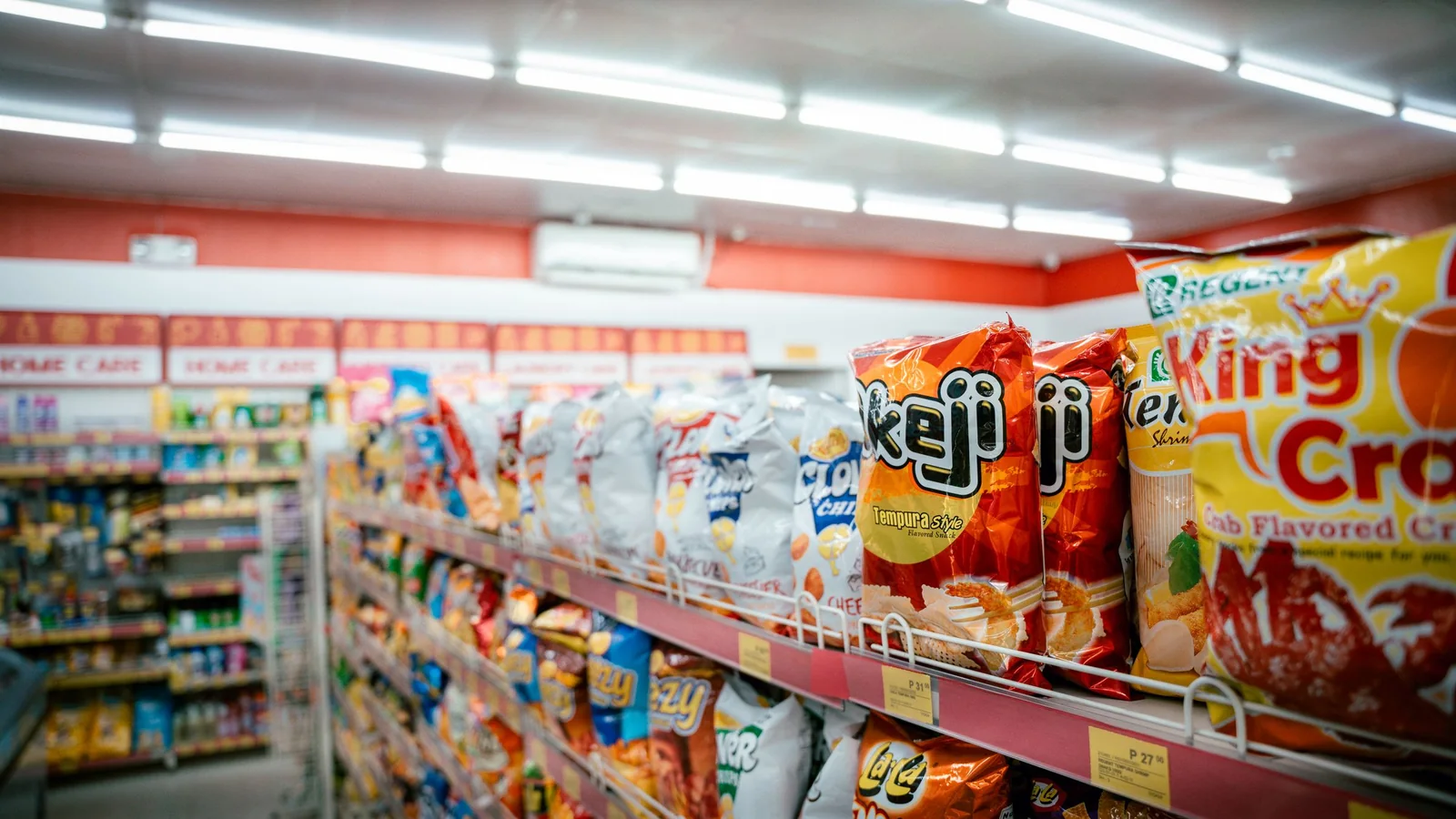
Start with intake. According to the CDC's most recent national survey, ultra-processed foods made up 55% of all calories eaten in the United States between 2021 and 2023. For children and teens the share reached nearly 62%, meaning the average American child now gets most of their fuel from group 4. The single largest sources are not exotic: sandwiches and burgers, sweet bakery products, sugary drinks, and savory snacks. The diet did not drift here. It was reformulated here, aisle by aisle.
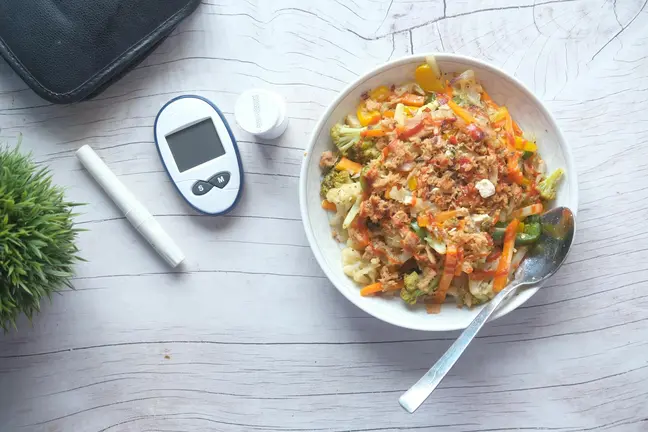
Now lay the disease curves alongside it. Over the same decades that ultra-processed food climbed toward the majority of calories, US adult obesity rose to about 40%, roughly 38 million Americans developed diabetes, and an estimated 98 million more slid into prediabetes. Correlation is not proof, and obesity has many causes. But the metabolic-ward trial shows these foods can drive the exact overeating that feeds those curves, which makes their rise hard to wave away as a bystander.
The burden also lands first on children. Diets dominated by ultra-processed food in childhood are linked to earlier weight gain and to metabolic problems, including type 2 diabetes, that once appeared mainly in adults. A generation is being introduced to these products as the default first food, and taste preferences set early tend to stick.
And the burden is not shared evenly. Ultra-processed food is cheap, shelf-stable, and heavily marketed, so it concentrates where money and time are tightest. National purchase data show the lowest-income and lowest-education households buy the highest proportion of ultra-processed groceries, and people with low food security eat noticeably more of it. Part of the reason is brutally simple arithmetic: ultra-processed calories can cost roughly a third of what minimally processed calories cost per calorie. When the cheapest, most available, longest-lasting option is also the most harmful, "just eat better" stops being useful advice and becomes a question of food policy and access. The same engineered diet is now exported worldwide, with ultra-processed intake rising fastest in countries that are adopting the American supermarket.
The honest part: not all of it is equal
None of this means every packaged product is out to get you, and pretending otherwise would undercut the real message. Processing itself is not the enemy. Freezing vegetables, canning beans, fermenting yogurt, and milling whole grains are all forms of processing that make good food cheaper, safer, and more accessible. Some technically ultra-processed items, such as plain whole-grain bread, baked beans, or a basic tub of unsweetened soy milk, are reasonable choices that do not behave like a soda.
The risk is concentrated in specific actors. Sugary drinks, processed and reconstituted meats, refined sweet and salty snacks, and confectionery are the products most consistently tied to harm. Those are the ones worth cutting first and hardest. The point of all the data above is not guilt over a birthday cake or a convenient frozen dinner on a hard week. The shift that matters is when group 4 quietly becomes the foundation of the diet rather than the exception, because then the population-level consequences are exactly what the evidence predicts.
How to eat fewer ultra-processed foods
The fix is not a cleanse or a banned-foods list. It is a small set of habits that shift the ratio of your plate over time, and they work without perfect discipline or a bigger budget.
Learn to spot it in five seconds
Turn the package over and read the ingredient list, not the front-of-box claims. Three quick signals flag group 4: a long list (more than five or six items), ingredients that read like a lab inventory rather than a recipe (maltodextrin, modified starch, emulsifiers, isolates, high-fructose corn syrup, artificial colors and flavors), and the home-kitchen test, which asks whether you could make this from recognizable ingredients in your own kitchen. If the answer is clearly no, it is probably ultra-processed.
Swap, do not suffer
Trade up one habit at a time, choosing the realistic version rather than the ideal one. A few that stick:
- Sugary drinks for water, sparkling water, or plain coffee and tea. This is the highest-value single swap there is.
- Flavored fruit yogurt for plain yogurt with real fruit you add yourself.
- Packaged breakfast cereal or pastries for oats, eggs, or a genuinely low-sugar cereal you have actually checked.
- Chips and refined snack bars for nuts, fruit, popcorn, or a higher-protein, lower-sugar snack.
- Refined white pasta for a bean or whole-grain version, such as chickpea or lentil pasta, or pair refined crackers with a look at what actually matters on a cracker label.
Cook the anchor, buy the rest
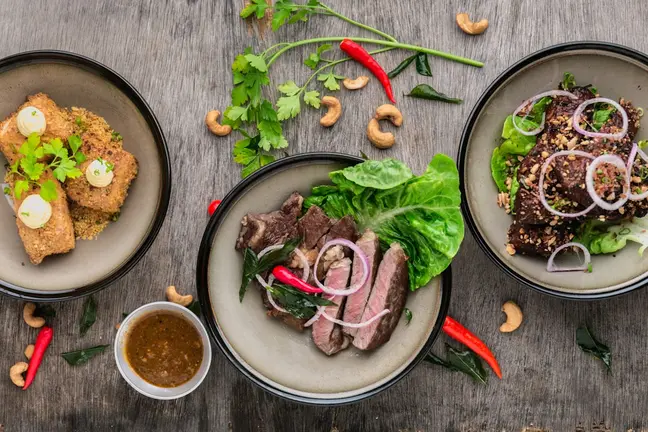
You do not need to make everything from scratch. Aim to base most meals on group 1 and group 3 foods, vegetables, fruit, beans, eggs, plain dairy, fish, and whole grains, then let convenience products fill the gaps rather than the center. Frozen vegetables, canned beans and fish, and plain bagged grains are fast, affordable, and not the problem. Building a pantry of whole and minimally processed staples makes the default meal the better one.
Protect kids by shaping the environment, not policing the table
Children eat what is in the house and what they are served. Keep the most engineered products as occasional rather than stocked, offer water as the default drink, and put fruit and other whole snacks within reach. Lowering the sugar and additive load of the everyday foods, rather than banning treats outright, trains a child's palate toward real food without turning meals into a fight.
Aim for fewer, not zero
An 80/20 approach beats an all-or-nothing one you cannot keep. If most of your meals are built on real food, the occasional ultra-processed item is not worth a second thought, and the dose-response data are reassuring here: moving from a diet that is mostly group 4 to one where it is the minority captures most of the benefit. Progress, not purity, is what the evidence rewards. For the wider picture on how daily eating compounds into long-term health, our guide to evidence-based healthy aging ties these habits together, and the same shift quietly supports healthier cholesterol and a more resilient immune system.
Frequently asked questions
How bad are ultra-processed foods, really?
Bad enough that the evidence has moved past hand-waving. A controlled NIH trial showed that an ultra-processed diet caused people to eat about 500 extra calories a day and gain weight, and a 2024 review of nearly 10 million people graded the links to cardiovascular and all-cause death, type 2 diabetes, and common mental disorders as convincing or highly suggestive. The risk is real and it scales with how much of your diet these foods make up. It is not, however, a poison or an instant danger, and the worst actors (sugary drinks, processed meats, refined snacks) carry far more risk than a plain whole-grain bread.
Why are ultra-processed foods bad for you?
Through several mechanisms at once rather than a single villain ingredient. They are engineered to be overeaten, they are soft and calorie-dense so you consume more before feeling full, they are stripped of the fiber and intact protein that signal satiety, their additives can disturb the gut and promote inflammation, and they displace the vegetables, beans, and whole grains that protect health. The combination is what does the damage.
What is the difference between processed and ultra-processed food?
Processed foods (NOVA group 3) are real foods preserved or improved with a few kitchen-type ingredients, like canned beans, cheese, salted nuts, or fresh bread. Ultra-processed foods (group 4) are industrial formulations made mostly from refined extracts and additives, with little intact whole food left, such as soft drinks, packaged snacks, and reconstituted meats. The simplest test: could you roughly recreate it from recognizable ingredients in a home kitchen? If not, it is likely ultra-processed.
What are some examples of ultra-processed foods?
The most common ones in the American diet are soft drinks and other sweetened beverages, packaged sweet and salty snacks (chips, cookies, candy, granola bars), most mass-market breads and breakfast cereals, instant noodles and packaged ready meals, reconstituted meat products like hot dogs, chicken nuggets, and many deli meats, flavored yogurts, and energy and sports drinks. The shared thread is a long ingredient list full of additives and refined extracts rather than recognizable whole foods. By contrast, plain yogurt, canned beans, cheese, and fresh bread are processed but not ultra-processed.
Are all processed foods bad?
No. Processing covers everything from freezing peas to milling flour, and much of it makes nutritious food safer, cheaper, and more available. Canned beans, frozen vegetables, plain yogurt, canned fish, and whole-grain bread are processed and genuinely good choices. The concern is concentrated in ultra-processed products, and even there, the realistic goal is to cut back rather than eliminate.
Is bread, yogurt, or oat milk ultra-processed?
It depends on the specific product. A plain fresh loaf from the bakery is a processed food, while a soft, long-shelf-life sandwich bread with added emulsifiers and dough conditioners is ultra-processed, though a plain whole-grain version is one of the more benign group 4 foods. Plain unsweetened yogurt is minimally processed; sweetened, flavored, thickened yogurt is ultra-processed. Oat and soy milks vary widely, so a short ingredient list (oats or soy, water, maybe a little salt) is the better sign. As always, the ingredient list tells you more than the label on the front.
How can I tell if a food is ultra-processed?
Read the ingredient list and watch for three things: a long list, ingredients you would not find in a home kitchen (maltodextrin, modified starch, protein isolates, emulsifiers, artificial colors and flavors, high-fructose corn syrup), and a product you clearly could not make from whole ingredients yourself. Any of the three is a strong hint you are holding group 4. Nutrition claims on the front of the box (made with whole grain, all natural, high protein) do not tell you whether a food is ultra-processed.
Can you be healthy and still eat ultra-processed foods?
Yes. The evidence is about proportion, not perfection. If most of your meals are built from whole and minimally processed foods, an occasional ultra-processed item fits comfortably into a healthy diet. The dose-response data suggest most of the benefit comes from moving these products out of the center of your diet, not from eliminating them entirely.
Are ultra-processed foods addictive?
"Addictive" is debated, and the honest answer is that some ultra-processed foods, especially those combining refined carbohydrate and fat, can trigger eating patterns that look like addiction for some people, with cravings and loss of control. Researchers are still working out whether that meets the formal definition of addiction. What is clearer is that these foods are deliberately engineered to be hard to stop eating, which is enough to take seriously regardless of the label.
The bottom line
Ultra-processed food is the rare nutrition story where the alarm is justified by the data rather than the adjectives. It now makes up the majority of what Americans, and especially American children, eat; a controlled trial shows it drives overeating directly; and the population evidence links it to higher rates of the diseases that kill and disable the most people. The honest nuance, that processing is not inherently bad and that the goal is fewer rather than zero, makes the core message more credible, not less. You do not need a perfect diet. You need most of your plate to be real food, and the steady shift in that direction is one of the highest-leverage things you can do for your long-term health.
Written to inform your everyday food choices, not to diagnose or treat any condition. If you manage diabetes, heart disease, a mental-health condition, or another illness, talk with your doctor or a registered dietitian about the eating pattern that fits your needs.