Walk down the cracker aisle and almost every box is making a promise. Organic. Gluten-free. Grain-free. Made with whole grains. Olive oil. Ancient grains. Baked with seeds. The problem is that none of those phrases, on their own, tells you whether the cracker is a genuinely strong everyday choice or just a better-sounding version of a snack food - and the marketing is designed to be read before you ever flip the box over.
The good news is that crackers are one of the easiest packaged foods to judge well, because the answer is almost always on the back. Once you know how to read the ingredient list, the fiber and sodium numbers, the serving size, and the legal meaning behind the front-of-pack claims, the better box usually becomes obvious in about thirty seconds. You stop shopping by adjective and start shopping by label.
This guide breaks down what actually matters when you compare healthy crackers, where shoppers get distracted, and how to build a snack worth repeating around the box you pick. If you want to compare real options as you read, our crackers collection spans the main types - seed, whole-grain, almond-flour, and simple olive-oil saltines - and the same checklist below works on any of them. For the bigger picture on two of the numbers that matter most, our guide to fiber and blood sugar balance basics pair well with this one.
Key takeaways
- Read the back, not the front. No single front-of-pack claim - organic, gluten-free, grain-free, or "made with whole grains" - tells you whether a cracker is genuinely strong.
- Whole food first. The best crackers list a whole grain, seed, nut, or legume as the first ingredient, not a refined flour.
- Aim for fiber, watch sodium. Look for about 3 grams of fiber or more per serving, and keep sodium reasonable for how many you actually eat - often 140 to 200 mg.
- Seed oils are not the main event. In a cracker the oil is a small part of the recipe; fiber, sodium, and whole-food ingredients move the needle far more.
- Match the cracker to the job. A sturdy seed cracker for a snack and a plain saltine for soup are held to different standards, and both can be the right buy.
- Our top snack-cracker picks: Top Seedz 6 Seed and Mary's Gone Super Seed. Maximum seed fiber in the first, a sturdy 5-gram-protein dipper in the second; Simple Mills covers grain-free, and Suzie's olive-oil saltine is the honest everyday soup cracker.
- Pair it with protein. A cracker becomes a real snack when you add cheese, hummus, nut butter, tuna, or eggs.
The short answer: what makes a cracker actually healthy?
A genuinely healthy cracker starts with a whole-food first ingredient - whole grains, seeds, nuts, or legumes - brings at least about 3 grams of fiber per serving, keeps sodium reasonable (often under 140 to 200 mg), and adds little or no sugar. No single front-of-pack claim guarantees any of that; the back of the box does.
Put simply, a strong cracker is defined by what is in it and how you use it, not by the most flattering word on the front. The rest of this guide is really one idea expanded: match the cracker to its job, then check the label against that job. A sturdy seed cracker meant to anchor a snack is held to a different standard than a plain saltine you want for soup, and both can be the right buy in the right situation.
Why so many cracker labels sound healthier than they eat
Crackers live in an awkward middle ground between staple food and convenience snack. Some are closer to bread in a shelf-stable format, built on whole grains and seeds. Others are essentially refined flour, starch, oil, and salt pressed into a crisp shape. Both can fit different moments, but they should not be judged by the same standard, and the front of the box rarely tells you which one you are holding.
The deeper issue is that packaging tends to highlight a single positive trait while staying quiet about the rest. A cracker can be certified organic and still be low in fiber. It can be gluten-free and still be mostly starch. It can be made with olive oil and still deliver more sodium than you expected for a small serving. It can be studded with seeds on the front and still behave more like a party snack than an everyday base.
That does not make those claims meaningless. It means they belong after the fundamentals, not before them. The shoppers who consistently buy better crackers are not the ones chasing the right buzzword - they are the ones who treat the front of the box as a starting filter and let the back of the box make the decision.
Decode the front of the box: what cracker claims legally mean
Some front-of-pack phrases are regulated and genuinely useful. Others are marketing language with no fixed definition. Knowing which is which turns the front of the box from a distraction into a quick screening tool. Here is what the most common cracker claims actually mean under U.S. labeling rules.
| Front-of-pack claim | What it legally means | How to use it |
|---|---|---|
| Low sodium | 140 mg of sodium or less per serving (FDA-defined). | A real, verifiable claim - one of the few worth trusting at a glance. |
| Very low sodium | 35 mg or less per serving (FDA-defined). | Genuinely low; useful if you are watching sodium closely. |
| Good source of fiber | 10 to 19% of the Daily Value, about 2.8 to 5.3 g per serving. | A meaningful amount, not a token - a good baseline for an everyday cracker. |
| High fiber / excellent source Best | 20% of the Daily Value or more, about 5.6 g or more per serving. | Strong for a cracker; usually signals a seed or whole-grain base. |
| 100% Whole Grain stamp | All grain is whole grain; at least 16 g whole grain per serving. | The most reliable whole-grain signal on a box. |
| Whole Grain stamp (basic) | At least 8 g whole grain per serving, but refined grain may also be present. | Good, but check the ingredient list for refined flour too. |
| Made with whole grains / multigrain | No minimum - can be mostly refined flour with a little whole grain added. | Ignore it; go straight to the ingredient list to verify. |
| Organic, gluten-free, grain-free, non-GMO | Sourcing and dietary filters, not nutrition guarantees. | Use them to narrow the shelf, never to make the final call. |
Sodium and fiber claim thresholds are set by the FDA and measured per labeled serving; whole-grain stamp minimums are set by the Whole Grains Council. The pattern is consistent: the regulated nutrient claims (low sodium, good source of fiber) are dependable, while the vaguer grain and lifestyle words need the ingredient list to back them up.
Read the ingredient list first, not the marketing
The ingredient list is where a cracker tells the truth fastest. FDA rules require ingredients to be listed in descending order by weight, so the first two or three ingredients are most of what you are actually eating. For an everyday cracker, you want that foundation to look like a food pattern you would recognize: whole grain flour, seed flour, whole seeds, nuts, or legumes - something with nutritional substance behind it. If the first ingredients are refined flour, starches, and oil, the cracker is not automatically bad, but it is bringing more crunch than staying power.
This is also where the grain claims get tested. The single most useful trick is the first-ingredient test: if the first ingredient says "whole" - whole wheat flour, whole grain oats, whole grain brown rice - the product is likely, though not guaranteed, to be predominantly whole grain. If it says "wheat flour," "enriched flour," "unbleached flour," or "multigrain," that usually means refined flour with the bran and germ - and much of the fiber - removed. "Multigrain" only means several grains were used; it says nothing about whether any of them are whole.
A few practical reads from the ingredient list:
- Seeds and whole grains up top: flax, sunflower, pumpkin, chia, sesame, brown rice, quinoa, or oats in the first ingredients usually signals more fiber and texture.
- Short and recognizable beats long and engineered: a cracker built from seeds, a flour or two, an oil, and salt is generally a stronger pick than one padded with isolated starches, gums, and added sugars.
- Watch the sweeteners: cane sugar, malt, honey, or syrups near the front of a savory cracker are a quiet way to make it more snackable than nourishing.
None of this requires memorizing chemistry. It is mostly a habit of reading two lines - the first few ingredients and the fiber number - before the front-of-pack claims get a vote.
Fiber: the fastest tell of a stronger cracker
If you only compare one number after serving size, make it fiber. Fiber is what most separates a substantial cracker from a highly refined one, it drives how full the snack actually keeps you, and it tends to track with a better ingredient base. It also matters beyond satiety: fiber slows digestion, which helps blunt the blood-sugar spike a plain refined cracker can cause - one reason a seed cracker behaves so differently from a saltine even when the calories look similar.
The FDA Daily Value for fiber is 28 grams, and the claim thresholds give you clean targets. About 2.8 grams per serving (10% of the Daily Value) is the floor for a "good source of fiber"; around 5.6 grams (20%) earns "high fiber." For an everyday cracker, roughly 3 grams or more is a sensible benchmark - enough to be a real contribution rather than a rounding-up-from-zero token. A box with 0 to 1 gram of fiber per serving should not be treated as a nutritional upgrade just because the front says organic, artisan, or gluten-free.
That does not mean every cracker must be a fiber powerhouse. A plain cracker for soup has a different job. But if you are reaching for crackers as a regular snack, fiber is the number that most reliably points toward the better box. If raising your daily fiber is a broader goal, our complete guide to fiber explains why most people fall short and how snacks like seed crackers can quietly help close the gap.
Sodium: the number that quietly decides the cracker
Crackers are small, salty, and easy to eat without noticing, which makes sodium one of the biggest hidden differences in the aisle. Two boxes can look almost identical until you compare sodium on the same serving size - and then one turns out to carry twice the salt of the other. The Dietary Guidelines for Americans suggest keeping sodium under 2,300 mg a day, and most Americans already run well past that at around 3,400 mg, so the snack aisle is a sensible place to claw some back.
The easiest mistake is ignoring portion reality. FDA serving sizes reflect what people typically eat, not what you should eat or what you actually will. If the label lists five crackers as a serving and you routinely eat ten or twelve, the sodium number you care about is effectively doubled. Always do the quick math on the portion you really reach for.
Here is the useful frame: a cracker is often a delivery vehicle for something salty - cheese, hummus, smoked fish, soup. The saltier your topping, the more you want the cracker itself to stay modest, so the two together do not blow past your budget. A cracker does not have to be labeled "low sodium" (140 mg or less per serving) to earn a place in your pantry, but it should make sense for how you use it. When you are torn between two boxes, compare sodium per serving against the real number of crackers you eat, and the better everyday option usually settles the argument itself.
Seed oils, olive oil, and fat quality: the honest version
The oil conversation around crackers has gotten loud, and a lot of it is more heat than light. Some shoppers now treat any seed oil - sunflower, safflower, canola - as a dealbreaker, while a front label that says "olive oil" gets an automatic pass. The accurate picture is more boring, and more useful.
On the science, the current weight of evidence does not support the idea that the seed oils used in crackers drive inflammation. Systematic reviews of more than fifteen randomized controlled trials have found that linoleic acid, the main omega-6 fat in seed oils, does not raise inflammatory markers in people; only a tiny fraction of it (roughly 0.2%) converts to the compound critics worry about. Reviews from groups including the Johns Hopkins Bloomberg School of Public Health, and dietary guidance from the World Health Organization, place these oils within a healthy eating pattern, not against it. Where seed oils genuinely deserve scrutiny is the company they keep: they are everywhere in ultra-processed snack foods, and it is the refined, low-fiber, high-sodium package as a whole - not the oil molecule by itself - that is worth eating less of.
For crackers, that means the oil line is a weak place to make your decision. A cracker made with sunflower oil is not automatically worse than one made with olive oil, and "olive oil" on the front does not rescue a weak label everywhere else. Real examples make this concrete: the Simple Mills almond flour crackers we stock are built on almonds and seeds and use a little organic sunflower oil - a clean, whole-food cracker that a strict "no seed oils" rule would wrongly reject. Meanwhile the Suzie's organic saltines lead with extra virgin olive oil and are a lovely simple cracker, but they still contain gluten and are a refined-flour saltine, so the olive oil does not make them a fiber food. Judge the whole label. If anti-inflammatory eating is your real aim, our anti-inflammatory diet guide gives the dietary-pattern context that no single oil line on a cracker box can.
And if you would rather skip seed oils anyway, you have real gluten-free options here: Top Seedz bakes with olive oil and arrowroot, and Mary's Gone Crackers uses no added oil at all - just organic whole grains, seeds, and sea salt. Simple Mills crackers do use a modest amount of sunflower oil, which the evidence above puts in honest context.
Protein: helpful, but crackers do not need to do everything
One reason crackers disappoint as a snack is that shoppers expect the box itself to be complete. Most crackers are not a protein food, and forcing them into that role tends to produce expensive labels with only a marginal nutritional payoff. A few seed and legume crackers do bring a respectable 3 to 5 grams of protein per serving, which is a nice bonus - but it is rarely enough to anchor a snack on its own.
Protein still matters, especially for satiety. The smarter question is usually whether the cracker pairs well with protein rather than whether it provides much by itself. A sturdy, higher-fiber cracker next to hummus, Greek yogurt dip, cottage cheese, tuna, sardines, nut butter, or edamame is almost always a better snack than a slightly higher-protein cracker eaten alone. The fiber-plus-protein combination is what actually keeps you full and steadies the blood-sugar response.
So the best healthy cracker is often the one that makes balanced snacking easy, not the one that wins every nutrient category by itself. For building genuinely filling plant-forward snacks and meals, our complete guide to plant-based protein covers the pairings worth keeping on hand.
Match the cracker to the job: types compared
Most cracker confusion disappears once you stop treating "cracker" as one category. There are really several, each with a different base, a different nutritional tendency, and a different job it does best. Knowing the type tells you what to expect before you even read the panel.
| Type | Typical base | Fiber tendency | Best job |
|---|---|---|---|
| Pure-seed crackers High fiber | Mixed seeds (flax, sunflower, pumpkin, chia, sesame) plus a binder | Often 3 to 5 g or more | An everyday snack base with real staying power. |
| Whole-grain + seed | Brown rice, quinoa, or oats blended with seeds | Usually a good source (about 3 g) | An all-purpose cracker for toppings, dips, and soup. |
| Nut / almond flour | Almond flour with seeds, tapioca, or cassava | Moderate (about 2 to 3 g) | Grain-free snacking with good fat and flavor. |
| Seed-flour (grain-free) | Ground sunflower, pumpkin, and flax flours | Moderate to good | A grain-free everyday cracker with some protein. |
| Veggie / sweet-potato | Vegetable plus a flour and oil | Varies widely - check the panel | Flavor-forward snacking; verify the label individually. |
| Simple / saltine style | Refined or organic wheat flour, oil, salt | Low (0 to 1 g) | Soup, travel, cheese boards, a sensitive stomach. |
These are tendencies, not guarantees - always confirm fiber and sodium on the specific box. But starting from the type gets you most of the way there: if you want an everyday snack with staying power, you are usually choosing among the seed and whole-grain rows, while the simple-saltine row is a situational tool rather than a nutritional anchor.
The crackers we carry, compared
We stock crackers across that whole spectrum so you can match the box to the job instead of forcing one cracker to do everything. The point of the comparison below is not that one is "the healthiest" - it is that the best choice depends on whether you want maximum fiber, a grain-free option, an all-purpose base, or a simple cracker done well.
Quick comparison
Match the cracker to how you will use it
Five in-stock options across the main types. Use the same label habits from this guide - first ingredient, fiber, sodium for your real portion - and pick by the job you need done.
| Product | Base | Best for | Notable |
|---|---|---|---|
| Top Seedz Organic 6 Seed Crackers - 5 oz Six organic seeds bound with arrowroot and olive oil. | Pure seed | Maximum fiber and crunch as an everyday snack base. | Organic, gluten-free, grain-free, nut-free, keto- and paleo-friendly. |
| Mary's Gone Crackers Super Seed Classic - 4 oz Brown rice and quinoa blended with five seeds. | Whole grain + seed | An all-purpose cracker for dips, toppings, and soup. | Organic, gluten-free, vegan; 5 g protein per serving and a good source of fiber. |
| Simple Mills Almond Flour Crackers, Sea Salt - 4.25 oz Almond and seed flour with a little sunflower oil. | Almond flour | Grain-free snacking with good fat and a clean ingredient list. | Gluten-free, grain-free, Non-GMO Project Verified; whole-food ingredients. |
| Simple Mills Organic Seed Flour Crackers, Original - 4.25 oz Sunflower, pumpkin, and flax seed flours. | Seed flour | A grain-free everyday cracker with seed protein and fiber. | USDA Organic, gluten-free, kosher, Non-GMO Project Verified. |
| Suzie's Organic Saltines, Salt & Olive Oil - 8.8 oz Crisp organic saltine with extra virgin olive oil, in eight portion packets. | Simple saltine | Soup, cheese boards, and built-in portion control. | USDA Organic, non-GMO, kosher; contains gluten - a simple cracker done well. |
The honest takeaway: the seed and whole-grain options give you the most for an everyday snack, the grain-free options suit specific diets, and the saltine is a deliberately simple tool. Pick the row that matches your job, then check the panel against the targets above.
Build a better snack: pairings that make a cracker worth it
This is the part shoppers skip, and it matters more than finding a perfect box. Even a strong cracker becomes a light, short-lived snack eaten by itself - it is mostly carbohydrate and crunch. Pair it with protein, fat, and produce, and a decent cracker becomes a genuinely satisfying snack that holds you between meals and steadies the blood-sugar response. The pairing is what turns a purchase into something worth repeating.
A few simple frameworks worth keeping in rotation:
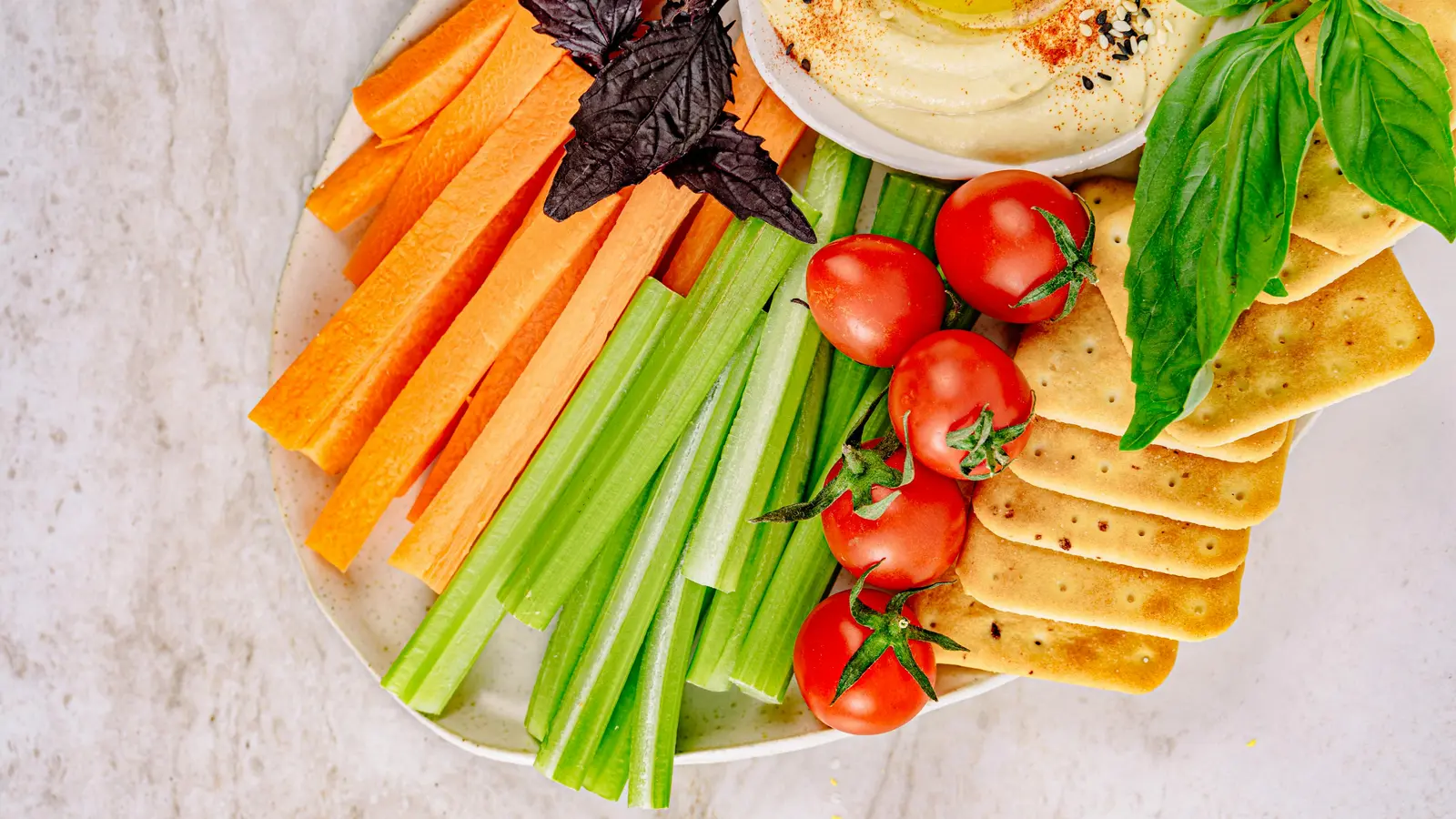
- Crackers + hummus + cucumber or pepper strips: more fiber, crunch, and staying power than crackers alone, and an easy plant-forward option.
- Crackers + cottage cheese or Greek yogurt dip + sliced vegetables: a fast, high-protein snack that keeps you full.
- Crackers + nut butter + apple or berries: portable, with more substance than a sweet snack on its own.
- Crackers + sardines or tuna + tomato: closer to a small meal, with protein and omega-3 fats doing the heavy lifting.
Notice the pattern: the cracker is the vehicle, and the topping supplies the protein and the satiety. That is also why a moderate-sodium cracker is so handy - it leaves room for a flavorful, sometimes salty topping without overloading the plate. If steadier energy is your aim, our guide to balancing blood sugar naturally explains why pairing carbohydrate with fiber, protein, and fat blunts the spike a bare cracker can cause.
A 30-second shelf test
You do not need a scoring spreadsheet in the aisle. When you are comparing two boxes, run them through this quick sequence and the stronger everyday cracker almost always stands out:
- Read the first ingredient. Whole grain, seeds, nuts, or legumes is a green light; refined flour or starch first is a caution.
- Check the fiber. Aim for about 3 grams or more per serving for an everyday snack; 0 to 1 gram means treat it as a treat.
- Do the sodium math. Multiply the per-serving sodium by how many crackers you really eat; if that number looks high, reach for a more moderate box.
- Scan for added sugar. A gram or two is fine; more than that in a savory cracker is a quiet downgrade.
- Match it to the job. Decide whether you want an everyday base or a simple cracker for soup, and hold each box to the right standard.
Five quick reads, and the front-of-pack adjectives never get the deciding vote. That habit, more than any single brand, is what consistently lands a better cracker in your cart.
When a cracker is just a cracker
Not every box needs to earn the title of health food. Sometimes you want a plain cracker for soup, travel, a cheese board, or simply something bland and convenient when your stomach is off. That is completely fine. The only real mistake is turning a situational product into an everyday nutritional halo item and eating it by the sleeve because the front said organic.
If a cracker is low in fiber, easy to overeat, and mostly refined flour, treat it as what it is: a useful convenience food, not the anchor of your snacking. That mindset actually makes shopping easier - it frees you to keep a simple cracker around for its job while saving your higher standards for the seed and whole-grain boxes you reach for most often.
Frequently asked questions
Are crackers healthy, or should I avoid them?
Crackers are not inherently healthy or unhealthy - it depends entirely on the cracker and how you use it. A seed or whole-grain cracker with a few grams of fiber, paired with protein, is a genuinely good snack. A refined-flour cracker eaten by the handful is closer to a treat. Read the first ingredient and the fiber number, and match the box to the job.
What are the healthiest crackers to buy?
The strongest everyday snack crackers have a whole-food first ingredient (seeds or whole grains), at least about 3 grams of fiber, moderate sodium for your real portion, and little added sugar. From the brands we stock, the picks that fit that profile: Top Seedz Organic 6 Seed for maximum fiber from a pure-seed base, Mary's Gone Crackers Super Seed for the sturdy all-purpose cracker (5 grams of protein, and the one to reach for with dips and toppings), Simple Mills Almond Flour or Simple Mills Organic Seed Flour for grain-free with a clean ingredient list, and Suzie's Organic Saltines with Extra Virgin Olive Oil as the honest everyday saltine upgrade. Whatever you pick, the label habits stay the same: first ingredient, fiber, sodium.
Are the seed oils in crackers bad for me?
For most people, no. The current weight of evidence does not show that the seed oils used in crackers, such as sunflower oil, increase inflammation. The bigger issue is the type of food they often appear in - highly refined, low-fiber snacks. A clean cracker made with a little sunflower oil is not a problem; judge the whole label rather than a single oil line.
How much fiber should a healthy cracker have?
There is no perfect rule, but about 3 grams or more per serving is a useful everyday benchmark. That is roughly the FDA threshold for a "good source of fiber" (around 2.8 grams, or 10% of the Daily Value), so it marks a meaningful contribution rather than a token amount.
How much sodium is too much in crackers?
Context matters more than a single cutoff. The FDA defines "low sodium" as 140 mg or less per serving, which is a helpful target for an everyday cracker. The key is to multiply the per-serving sodium by how many crackers you actually eat and to leave room for any salty topping. An occasional saltier cracker is fine; a daily one is where lower sodium pays off.
Are gluten-free crackers healthier than regular crackers?
Not automatically. Gluten-free matters a great deal if you have celiac disease or gluten sensitivity, but gluten-free crackers can still be built on refined starches and be low in fiber. Judge them by the same standard as any other cracker: first ingredient, fiber, sodium, and added sugar.
Are grain-free or almond-flour crackers low-carb or keto?
Often lower in carbohydrate than wheat crackers, but not always low enough to be strictly keto - it depends on the binders. Almond- and seed-flour crackers bring good fat and fiber, which is helpful, but check the net carbohydrate per serving against your own target rather than assuming "grain-free" means "low-carb."
Can crackers fit a weight-management plan?
Yes, when they are chosen and paired well. A higher-fiber cracker with a protein topping is a satisfying, portion-friendly snack. The trouble starts when low-fiber crackers are eaten straight from the box, since they are easy to overeat and do little for fullness. Portion onto a plate, pair with protein, and the cracker works for you rather than against you.
Are olive oil crackers healthier than regular crackers?
Sometimes, but rarely because of the oil alone. Olive oil is a stable, mostly monounsaturated fat, so an olive-oil cracker is often a slightly better pick - yet the oil is not usually what decides it. The current evidence does not show the seed oils used in crackers are harmful, so a regular cracker with more fiber, less sodium, and a whole-grain or seed-and-nut base can easily beat an "olive oil" cracker built on refined white flour. Read the whole label: aim for at least 3 grams of fiber, modest sodium, and a short ingredient list, and check where the oil actually falls in that list, since many "olive oil" crackers still use a blend.
What are refined crackers?
Refined crackers are made from flour with the bran and germ milled away. The label usually says "wheat flour," "enriched flour," or "white rice flour" as the first ingredient. Losing those layers strips most of the fiber and minerals, so a refined cracker typically has under 1 gram of fiber per serving and digests quickly. That does not make it a bad food; it makes it a light base that needs help from whatever you put on it. The tell is the first ingredient plus the fiber line: a "whole" grain or seeds up front and about 3 grams of fiber is the stronger pattern.
Do crackers have fiber or protein?
It depends entirely on the base. A refined saltine has under 1 gram of fiber and about 2 grams of protein per serving. Whole-grain crackers usually land around 2 to 3 grams of fiber. Seed crackers lead the category with roughly 3 to 4 grams of fiber and 3 to 5 grams of protein per serving (Mary's Gone Crackers Super Seed reaches 5 grams of protein, and nut-based almond-flour crackers bring about 3). No cracker is a protein food, though: even the best boxes work better paired with hummus, cheese, or tuna than eaten alone.
Are rice crackers healthier than wheat crackers?
Usually not by default. Most rice crackers are built on white rice flour, which is just as refined as white wheat flour - similar quick-digesting starch, often under 1 gram of fiber - so swapping wheat for rice buys you gluten-free, not healthier. The exceptions are whole-grain builds: Mary's Gone Crackers, for example, blends whole brown rice and quinoa with seeds, which brings real fiber and protein. Judge a rice cracker exactly like a wheat one: first ingredient, fiber at or near 3 grams, and sodium for your real portion.
Are non-GMO gluten-free crackers healthier?
Not automatically. Non-GMO describes how ingredients were sourced, and gluten-free describes what is absent. Neither says anything about fiber, sodium, or how refined the flour is, and a non-GMO, gluten-free cracker can still be plain starch. Treat both labels as tie-breakers rather than health claims. Simple Mills shows the combination done well: Non-GMO Project Verified and gluten-free, but what makes it a strong cracker is the almond and seed flour base, not the badges.
Bottom line
Healthy crackers are not a single product you can find by chasing the right word on the front of a box. They are a decision you make on the back: a recognizable whole-food first ingredient, a few grams of fiber, sodium that fits how many you really eat, minimal added sugar, and a pairing that brings protein. Decode the front-of-pack claims so they inform you instead of distracting you, match the cracker to its job, and let the simple boxes be simple. Do that, and you will buy better crackers consistently - no front-label hype required.
Sources
- FDA: Daily Value on the Nutrition and Supplement Facts Labels
- FDA: Serving Size on the Nutrition Facts Label
- FDA: Sodium in Your Diet
- Dietary Guidelines for Americans, 2020-2025
- Whole Grains Council: Identifying Whole Grain Products
- Johns Hopkins Bloomberg School of Public Health: The Evidence Behind Seed Oils' Health Effects