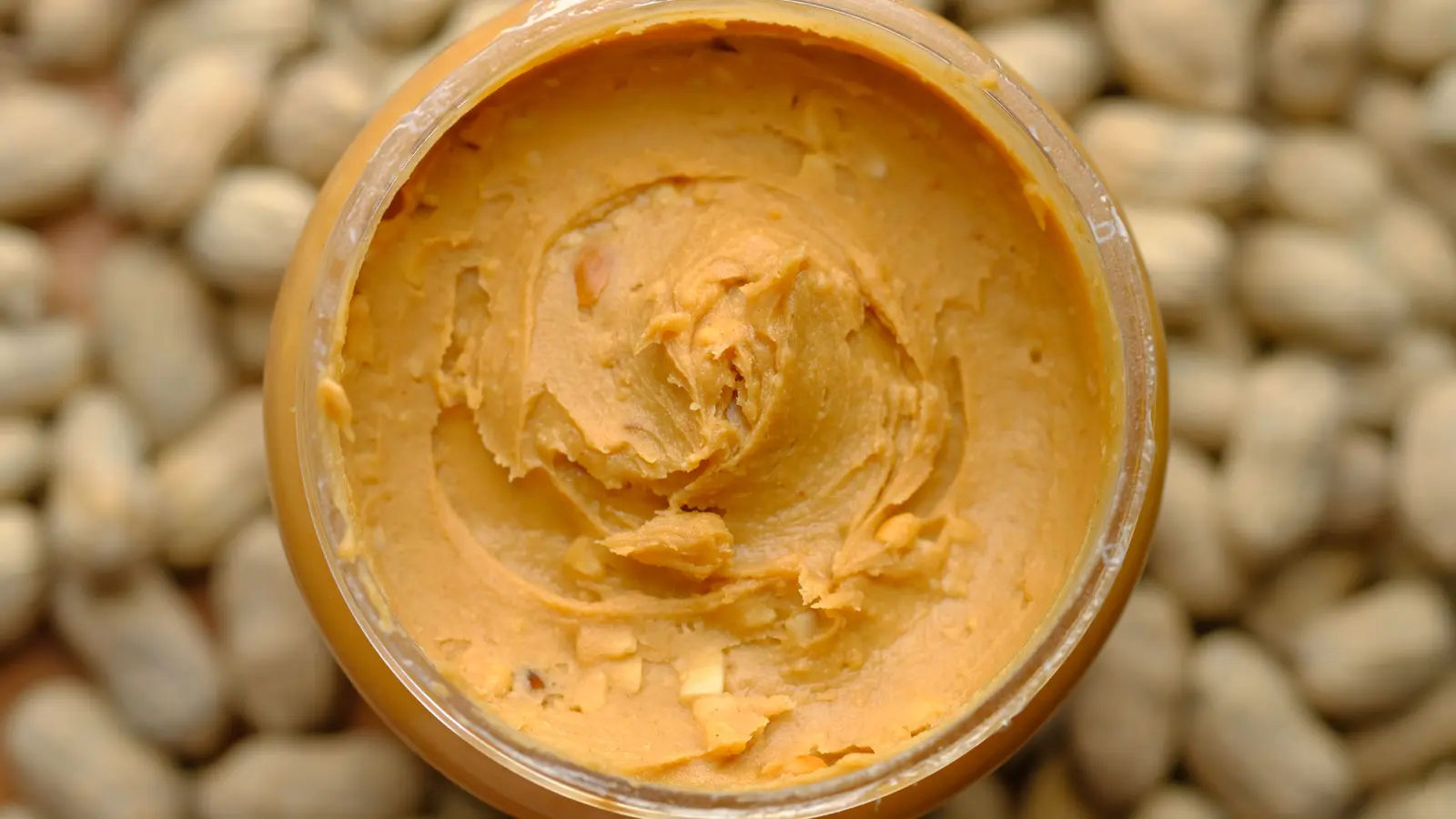
The oil pooled on top of a natural peanut butter jar is the closest thing this category has to an honesty seal. Peanut oil is liquid at room temperature, so a jar made of nothing but ground peanuts will always separate a little on the way to your pantry. The jars that never separate hold their shape with an added stabilizer fat, usually palm oil or fully hydrogenated vegetable oil, and that single difference decides most of what a peanut butter label can tell you.
Neither style is junk food, and peanut butter is a healthy choice by almost any reading of the nutrition panel. But knowing why the oil rises is what turns a wall of similar-looking jars into a ten-second decision.
The jar test, up front
- Peanut butter is a healthy default, not a cheat: a 2-tablespoon serving of a plain jar delivers roughly 190 calories, 7 to 8 g of plant protein, 2 to 3 g of fiber, and fat that is mostly unsaturated.
- The two-ingredient rule finds the healthiest peanut butter fast: the ingredient list should say peanuts, or peanuts and salt, and nothing else.
- Federal rules require anything labeled "peanut butter" to be at least 90 percent peanuts with no artificial sweeteners; a jar that says "peanut spread" is admitting its recipe goes past that allowance.
- Oil on top means no stabilizer. No-stir jars use palm oil or fully hydrogenated oil to keep the oil suspended, which is a texture and sourcing tradeoff rather than a meaningful nutrition penalty.
- Reduced-fat peanut butter is the aisle's real trap: it strips out unsaturated fat and refills the jar with refined-carb fillers for nearly the same calories. Powdered peanut butter is the honest version of that idea.
Is peanut butter healthy? Start with the two-tablespoon math
A peanut is a legume that eats like a nut, and grinding it into butter changes remarkably little. USDA data puts a 2-tablespoon serving of plain peanut butter at about 190 calories, 7 g of protein, and 16 g of fat, with 2 to 3 g of fiber on most labels plus niacin, magnesium, and vitamin E riding along. Most of that fat is monounsaturated and polyunsaturated, the same categories that make olive oil respectable.
The evidence on peanuts themselves is strong. Large cohort studies tracking hundreds of thousands of people have linked regular peanut and nut eating to lower rates of cardiovascular disease, and since 2003 the FDA has allowed a qualified health claim that eating 1.5 ounces of most nuts per day, peanuts included, "may reduce the risk of heart disease" as part of a diet low in saturated fat and cholesterol. The word qualified is doing real work there: the agency accepted the evidence as supportive but not conclusive, which is a fair description of where the science sits.
Here is the honest wrinkle those same Harvard researchers found: peanut butter specifically showed no significant association with lower heart disease risk, while whole peanuts did. Their explanation was not the butter. It was the company it keeps: white bread, jelly, sugary crackers, and sweetened jars. The spread is only as healthy as its recipe and its delivery vehicle, which is exactly why the label matters.
One caution belongs up front. At roughly 95 calories per tablespoon, peanut butter is one of the most calorie-dense foods in the pantry, and a "serving" straight from a soup spoon can quietly double. Measured portions keep it on the right side of the healthy snacking ledger.
The two-ingredient rule
Flip the jar around. The healthiest peanut butter has an ingredient list you can read in one breath: peanuts, or peanuts and salt. Every additional line is there for shelf behavior or taste, never for nutrition.
The word "natural" on the front will not settle it, because the FDA has never formally defined "natural" for this use. Some jars wearing the word still carry added sugar and stabilizer oils. The ingredient list is the only part of the package that cannot spin.
Salt is the one addition most people can wave through. Across the jars on our shelf, sodium runs from 0 mg in Crazy Richard's unsalted jar to about 100 mg per serving in salted brands, a modest slice of the 2,300 mg Daily Value. If you are watching sodium closely, unsalted single-ingredient jars make the choice simple.
What the word "spread" quietly admits
Peanut butter is one of the few foods with a federal recipe. Under FDA's standard of identity, anything sold as "peanut butter" must keep seasoning and stabilizing ingredients to no more than 10 percent of the jar by weight, which means at least 90 percent peanuts. Artificial flavors, artificial sweeteners, chemical preservatives, and color additives are not allowed at all, and fat cannot exceed 55 percent.
Cross those lines and the product legally becomes a "peanut spread," required to declare its actual peanut percentage on the label. Here is why that word is a poor proxy for quality. Justin's Classic sells as a peanut butter spread, and its entire ingredient list is peanuts and palm oil: no sugar, no salt. A conventional sweetened jar with four ingredients, sugar included, can still print "peanut butter" on the front. The stricter-sounding label is the shorter recipe.
Treat the word as a prompt to read the ingredient list, not as a verdict by itself.
Why the oil separates, and why that is a good sign
Freshly ground peanuts are a suspension of solids in their own oil. Left alone, the solids settle and the oil rises, the same way unfiltered juice stratifies. Stirring it back together is the entire price of a stabilizer-free jar.
Stabilized jars solve the problem chemically. A small dose of palm oil or fully hydrogenated vegetable oil, both solid at room temperature, raises the melting point of the fat blend enough to lock the peanut oil in place. The result is the no-stir texture most Americans grew up on.
Two tricks tame a natural jar. Store it upside down for a day or two before opening so the oil redistributes as it migrates, then give it one thorough stir. After opening, the refrigerator slows both separation and the slow oxidation that turns nut oils stale, at the cost of a firmer spread.
Six label lines, decoded
Six lines account for nearly every difference between jars. Here is what each one is doing there and how much weight to give it.
| Label line | Why it is there | How much it matters |
|---|---|---|
| Sugar, cane sugar, evaporated cane juice | Flavor. Classic sweetened jars add it for the taste many people expect. | Less than the fear suggests: typically 1 to 3 g per serving, a fraction of a soda. The better question is what else rides along with it. |
| Palm oil or palm fruit oil | A no-stir stabilizer that is solid at room temperature and keeps the peanut oil suspended. | Smaller than its reputation. Across the jars we stock, stabilized and unstabilized versions overlap at 2.5 to 3.5 g of saturated fat per serving, so palm oil is a texture and sourcing question more than a nutrition one. |
| Fully hydrogenated vegetable oil | The older no-stir stabilizer, used in conventional brands. | Fully hydrogenated oil contains no trans fat, and the partially hydrogenated oils that did carry it were phased out of the US food supply after 2018. It signals a conventional recipe rather than a hazard. |
| "No added sugar" on the front | A truthful claim that still says nothing about oils or salt. | Check the list anyway. Several no-sugar jars still use palm oil for texture. |
| "Natural" on the front | Marketing. The FDA has not formally defined the term for this use. | Treat it as decoration and go straight to the list. |
| "Reduced fat" | Fat is pressed out, then corn syrup solids and other starch fillers restore the texture. | The one line worth actively avoiding. Details below. |
The reduced-fat trap, and the powdered alternative that works
Reduced-fat peanut butter reads like a health upgrade and delivers the opposite trade. The fat removed is the mostly unsaturated kind that makes peanuts worth eating, and the space gets back-filled with corn syrup solids, maltodextrin, and added starches to restore spreadability. After all that engineering, the calorie savings per serving are trivial, and the jar has quietly become a sweeter, starchier product.
Powdered peanut butter is the same idea executed honestly. Pressing roasted peanuts removes most of the oil, and what remains is ground into a powder with a fraction of the calories: PB2 comes in at 60 calories, 1.5 g of fat, and 6 g of protein per 2-tablespoon serving, against about 190 calories for a regular jar. Part of that gap is honest fat removal and part is simple mass: 2 tablespoons of dry powder weighs 13 g where 2 tablespoons of spread weighs 32 g. The label stays short either way, and an organic version keeps it to organic peanuts, organic sugar, and salt.
One caveat: the job changes. Reconstituted powder makes a thin spread, and stripping the fat also strips some of the staying power that makes peanut butter satisfying. Where powder shines is anywhere the fat was optional: blended into smoothies, stirred through overnight oats, or folded into baking, where it adds peanut flavor and protein at a snack-calorie price.
The healthiest peanut butter we stock, by tier
Every jar below passed the same reading of its own label. They are ordered by how short the ingredient list is, which turns out to be the only ranking a peanut butter guide honestly needs.
Tier one is peanuts and nothing else. Add a stabilizer for no-stir convenience while keeping sugar out and you have tier two. Tier three is the classic sweetened style, worth choosing with open eyes rather than by accident. The powdered option sits apart, doing a different job.
Quick comparison
Seven jars, ranked by what is in them
Same axis for every row: what is in the jar beyond peanuts, straight from each label. Protein and sugar figures are per labeled serving.
| Product | Ingredient list | Per serving | Pick it for |
|---|---|---|---|
| Crazy Richard's Natural Creamy Peanut Butter One ingredient, zero sodium; also in crunchy. | Peanuts. | 190 cal, 8 g protein, 0 g added sugar, 0 mg sodium | The purist default. Nothing to audit, and the lowest-sodium jar on the shelf. |
| CB's Nuts Organic Creamunchy Peanut Butter Single ingredient, USDA Organic, USA-grown. | Organic peanuts. | 188 cal, 8 g protein, 0 g added sugar, 5 mg sodium | The organic upgrade, with a texture that splits the creamy-crunchy difference. |
| Once Again Organic Unsweetened Squeeze Pack Single-serve pouch, peanut-only facility. | Organic peanuts. | 200 cal, 8 g protein, 0 g added sugar, 0 mg sodium | Lunchboxes, travel, and desk drawers: portion control built into the packaging. |
| Peanut Butter & Co Simply Smooth No sugar added; also in Simply Crunchy. | Peanuts, palm oil, salt. | 190 cal, 7 g protein, 0 g added sugar, 100 mg sodium | No-stir convenience without sweetener: the middle path most households land on. |
| Justin's Classic Peanut Butter Spread Two ingredients, no added salt or sugar. | Peanuts, palm oil. | 210 cal, 7 g protein, 0 g added sugar, 25 mg sodium | A salt-free no-stir jar with an Orangutan Friendly sourced-palm commitment. |
| Peanut Butter & Co Smooth Operator The classic sweetened style; Crunch Time is its crunchy twin. | Peanuts, cane sugar, palm oil, salt. | 180 cal, 7 g protein, 3 g sugars, 100 mg sodium | The childhood-familiar sweet taste, chosen deliberately: 3 g of sugar is the whole toll. |
| PB2 Powdered Peanut Butter Oil pressed out; an organic version is also stocked. | Roasted peanuts, sugar, salt. | 60 cal, 6 g protein, 1 g added sugar | Smoothies, oats, and baking, where peanut flavor matters more than spreadable fat. |
If protein is the deciding factor, note how narrow the spread is: every full-fat jar lands between 7 and 8 g per serving. Pick by ingredient list and let the protein take care of itself; for bigger breakfast numbers, see our high-protein breakfast guide, where peanut butter plays a supporting role rather than the lead.
Peanut, almond, or tahini?
Nut-butter loyalty is mostly taste, because the big numbers barely move. Per USDA data and the labels on our shelf, a serving of peanut, almond, or sesame butter all land within about 20 calories of each other, and each brings 6 to 8 g of protein.
| Per serving | Peanut butter (32 g) | Almond butter (32 g) | Tahini (30 g) |
|---|---|---|---|
| Calories | about 190 | about 197 | 210 |
| Protein | 7 to 8 g | 6 to 7 g | 8 g |
| Fiber | 2 to 3 g | about 3 g | 1 g |
| Standout | Highest protein per dollar | Vitamin E (about half the daily value) and magnesium | Sesame flavor, works in dressings and sauces; naturally sugar-free |
Almond butter earns its premium mainly through vitamin E and magnesium; Justin's Classic Almond Butter keeps the list to dry roasted almonds and palm oil, and Once Again's organic almond packs keep it to almonds alone. For peanut-allergic households, single-ingredient tahini and cashew butter cover the same jobs; just note that sesame is itself a major allergen under FDA labeling rules, so check household allergies both ways. The same two-ingredient rule applies across the whole nut-butter shelf.
Frequently asked questions
Is peanut butter good for weight loss?
It can fit, with a measuring spoon involved. Protein and fat make peanut butter more filling per snack than most crackers or chips, and research on nut eaters consistently finds they do not gain more weight than nut avoiders. The risk is dose creep: at about 95 calories per tablespoon, an unmeasured scoop can turn a 190-calorie serving into 400. Measured on apple slices or oats it earns its place; eaten from the jar with a spoon, it rarely does.
Should I worry about aflatoxin in peanut butter?
Aflatoxins are compounds made by molds that can grow on peanuts, corn, and tree nuts in the field or in storage. US peanuts are among the most tightly screened crops for them: the FDA treats peanut products above 20 parts per billion as adulterated, growers sort and test below that line, and commercial roasting further reduces what little remains. Major-brand US peanut butter tests comfortably under the limit. Buy jars with normal turnover, store them sealed, and this is not a reason to skip peanut butter.
Is crunchy peanut butter healthier than creamy?
Not meaningfully. Crunchy and creamy versions of the same brand share the same ingredient list and nearly identical nutrition; the peanut pieces just escaped the final grind. Choose by texture. Three of the jars above have a crunchy twin on our shelf: Crazy Richard's crunchy in tier one, Simply Crunchy in tier two, and Crunch Time in tier three.
Do I need to refrigerate natural peanut butter?
Unopened, no. After opening, a single-ingredient jar keeps fine in a cool pantry for a couple of months, but refrigeration slows the oxidation that gradually turns nut oils stale and stops the oil from re-separating. The tradeoff is a firmer spread; ten minutes on the counter fixes that. Stabilized no-stir jars are built for the pantry either way.
How much peanut butter per day is reasonable?
One to two tablespoons covers most snack roles, and the nut research that links regular nut eating with better heart outcomes centers on about an ounce a day. The practical rule: count it as your fat-and-protein anchor for that snack or meal rather than a topping that sneaks in beside three others.
Is peanut butter keto-friendly?
Plain jars, yes in moderation. Two tablespoons of a single-ingredient peanut butter carry roughly 6 to 7 g of total carbohydrate with 2 to 3 g of fiber, landing near 4 g net. Sweetened jars spend part of your carb budget on cane sugar, so keto shoppers should stay in tier one or two; our keto snack guide covers the wider shelf.
The bottom line
Buy the jar whose label you can recite. Peanuts, maybe salt, is the whole recipe the category needs, and the single-ingredient jars on our shelf prove nothing is lost when the extras go. Take the no-stir convenience with open eyes, save the sweetened classics for deliberate nostalgia, put the powdered version in your smoothie rather than your sandwich, and let the oil on top tell you that you chose well.