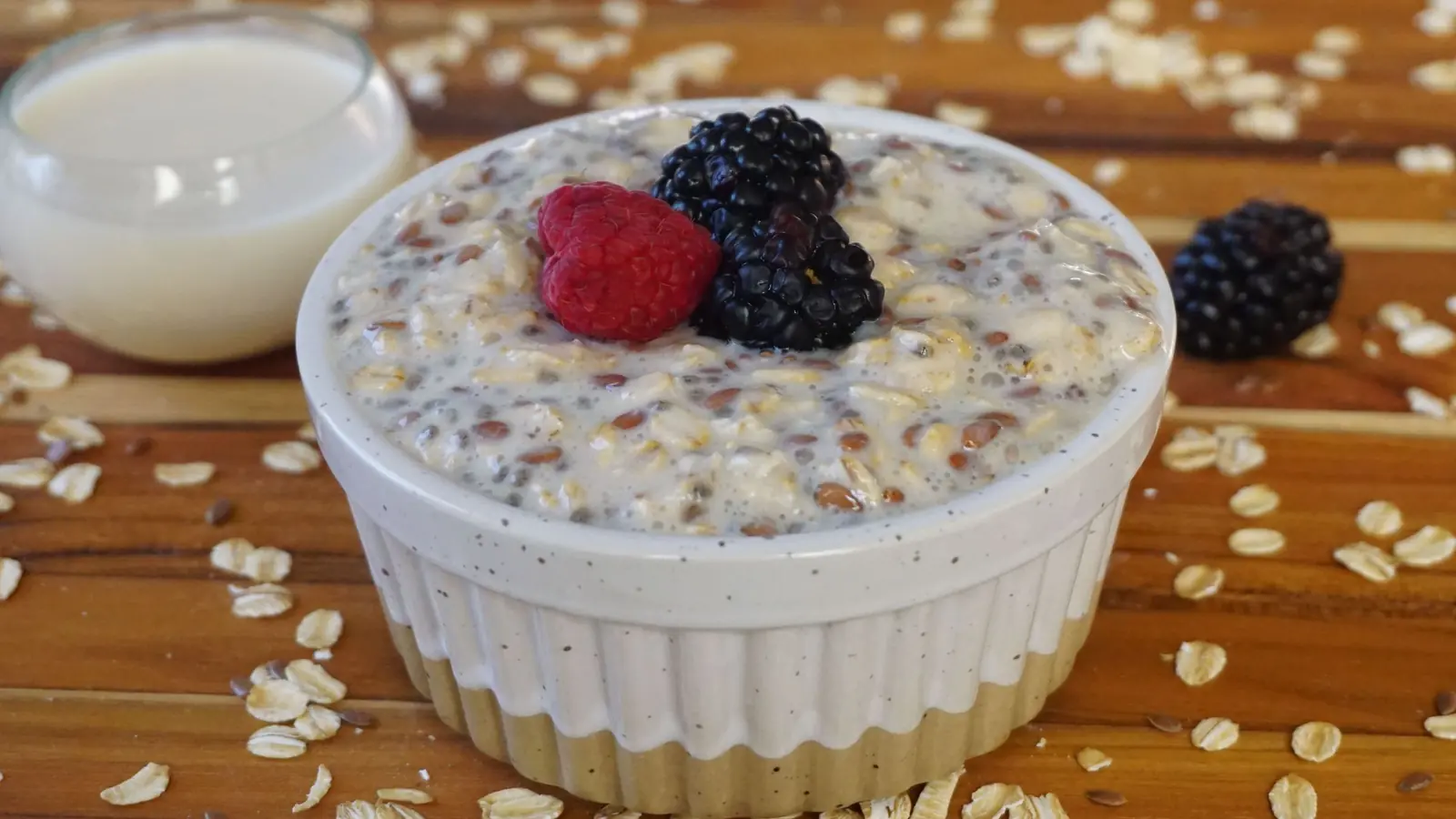
Overnight oats are less a recipe than a ratio. Once you own the ratio, you can stop hunting for the perfect recipe and build a jar from whatever is in the cabinet. Get the proportions of oats to liquid right, decide how thick you want it, and the flavor is just decoration on top.
This guide gives you a tested base recipe you can make tonight, plus the reasoning underneath it: which oats actually work, how to push a plain jar from a weak 8 grams of protein up past 25, how long the jars keep in the fridge before they turn, and how to fix the four ways overnight oats go wrong. The recipe card below is built to be saved, printed, and repeated.
Before you scroll to the recipe
- The base ratio is 1:1 oats to liquid by volume — about ½ cup rolled oats to ½ cup milk for a thick, spoonable jar. Add more liquid for a looser, drinkable texture.
- Use old-fashioned rolled oats. They soften without turning to paste. Instant oats go gluey; steel-cut stays firm unless you soak it far longer.
- One tablespoon of chia seeds per jar thickens the mix, adds fiber, and helps the oats hold their shape overnight.
- Plain overnight oats run about 8 grams of protein. A scoop of protein powder, ½ cup of Greek yogurt, or a mix of hemp and nut butter can take a jar past 25 grams.
- Stored below 40°F, a sealed jar keeps about 4 to 5 days. Add fresh fruit the morning you eat it, not on prep day, so the berries do not weep and soften the whole jar.
- No cooking, no heat. Cold liquid and time do the work; raw rolled oats are safe to eat once they have soaked and softened.
The base ratio: oats, liquid, and one spoon of chia
Everything else in this article hangs on one number. For a jar you eat with a spoon, use equal parts rolled oats and liquid by volume. Half a cup of oats to half a cup of milk gives you a thick, pudding-like base after an overnight soak. Want something looser that you can almost drink? Go to three-quarters of a cup of liquid. That is the whole trick, and it scales cleanly: one cup of oats to one cup of milk feeds two.
Chia seeds are the second lever. A single tablespoon per jar absorbs several times its weight in liquid and sets into a soft gel, which is why a jar with chia holds together instead of separating into wet oats and a puddle. Chia also brings fiber and a little plant-based omega-3 fat. Adding chia means nudging the liquid up by a couple of tablespoons to feed it. Our deeper look at how much chia to use and how it compares to flax covers the seed itself in detail.
A spoon of plain Greek yogurt is the optional third component. It is not required, but it makes the texture creamier and quietly adds protein. Stir it in with the liquid rather than layering it on top. Once you have those three dials — oats for body, liquid for looseness, chia and yogurt for creaminess — you can reproduce any overnight oats you have ever liked.
A tested high-protein overnight oats recipe
This is the version we keep coming back to. It lands around 30 grams of protein and 13 grams of fiber per jar, which is enough to carry you to lunch rather than leaving you rummaging for a mid-morning snack. Assemble it in the jar you will eat from, so there is nothing to wash but a spoon.
Tested recipe
High-Protein Overnight Oats
A no-cook, make-ahead jar built on the 1:1 ratio, with chia to thicken and a scoop of protein powder to push it past a real breakfast’s worth of protein. About 30 grams of protein and 13 grams of fiber per jar.
- Prep 5 minutes
- Chill 8 hours (overnight)
- Makes 1 jar
- Protein about 30 g
Ingredients
- ½ cup (45 g) old-fashioned rolled oats
- ¾ cup (180 ml) milk of choice (dairy or unsweetened plant milk)
- 1 scoop (about 30 g) vanilla protein powder
- 1 tablespoon chia seeds
- 1 teaspoon maple syrup or honey (optional)
- Pinch of salt
- ½ cup mixed berries, to top the morning you eat it
Instructions
- Add the rolled oats, chia seeds, protein powder, and pinch of salt to a jar or container with a lid, and stir the dry ingredients together so the protein powder does not clump.
- Pour in the milk and the maple syrup, then stir well, scraping the bottom, until no dry powder remains. Protein powder thickens as it sits, so the extra liquid here is deliberate.
- Seal the jar and refrigerate at least 6 hours, ideally overnight. The oats and chia absorb the liquid and soften.
- In the morning, stir once. If it is thicker than you like, loosen it with a splash of milk. Top with the berries and eat cold, straight from the jar.
Nutrition is estimated for the recipe as written using unsweetened almond milk; dairy milk or a scoop of Greek yogurt raises the protein further. Values shift with your specific milk, powder, and toppings.
The recipe is deliberately plain so you can see the machinery. From here, flavor is a matter of what you stir in and what you pile on top, and getting more protein is a matter of which add-in you reach for. Both are below.
Which oats to use, and which to skip
The oat you buy decides the texture more than any other choice. Overnight oats rely on cold soaking rather than heat, so the oat has to soften on its own in the fridge. That rules some types in and some types out.
| Oat type | Texture after an overnight soak | Good for overnight oats? |
|---|---|---|
| Old-fashioned rolled oats | Soft and creamy, still holds its shape | Yes — the default choice |
| Quick (instant-cook) oats | Very soft, slips toward mushy | Works in a pinch; expect a looser, softer jar |
| Steel-cut oats | Stays firm and chewy | Only if you like a firm bite; soak two nights or use more liquid |
| Instant flavored packets | Turns pasty and gluey, loses structure | Skip — pre-cooked and often pre-sweetened |
Rolled oats are the answer for almost everyone. They are simply whole oat groats steamed and pressed flat, so they drink up liquid overnight and keep a pleasant, distinct texture. A plain organic rolled oat with one ingredient on the label is all you need; a whole-grain rolled oat also carries the soluble fiber (beta-glucan) that earns oats their reputation. The FDA’s authorized health claim ties about 3 grams a day of that beta-glucan to a lower risk of heart disease, and a serving of oats contributes a meaningful share of it.
Steel-cut oats can make excellent overnight oats if you like chew, but they are cut rather than rolled, so they resist water and stay firm. Give them two nights or a longer soak, and add extra liquid. Instant flavored packets are the one type to leave on the shelf: they are pre-cooked, frequently pre-sweetened, and collapse into paste.
How to make overnight oats actually high in protein
Here is the honest weakness of a plain jar. Oats and milk alone land near 8 grams of protein, and half of that comes from the milk. That is a light breakfast, and it is the reason a bowl of overnight oats can leave you hungry by ten. If you want the jar to hold you, you have to build the protein in on purpose. This is the same arithmetic behind our high-protein breakfast ideas, applied to one format.
Each add-in pulls a different amount of weight. The table shows what a normal serving of each contributes, so you can mix and match to a target instead of guessing.
| Add-in | Typical amount | Protein added | What else it does |
|---|---|---|---|
| Protein powder (whey or plant) | 1 scoop (about 30 g) | 20–25 g | The biggest single lever; add extra liquid to offset it |
| Greek yogurt (plain) | ½ cup | about 10 g | Adds creaminess and a little tang |
| Hemp hearts | 2 tablespoons | about 6 g | Nutty topper; also brings omega-3 fats |
| Nut or seed butter | 1 tablespoon | 3–4 g | Flavor and staying power; watch the calories |
| Chia seeds | 1 tablespoon | about 2 g | Mostly a thickener and fiber; small protein bump |
| Milk instead of water | ¾ cup dairy | about 6 g | Free protein; soy milk matches it, almond milk does not |
Protein powder is the fastest route, which is why the recipe above uses it: one scoop of a clean vanilla powder does more than everything else on the list combined. Stir it into the dry oats first so it does not clump, and remember it thickens the jar, so the recipe already accounts for that with more liquid. If you would rather skip powder, a stack of half a cup of Greek yogurt plus two tablespoons of hemp hearts gets you to roughly the same place with whole foods. Either way, the goal is a breakfast that reads like a meal, not a snack. Want to know how much protein a day you should be aiming for? Our roundup of high-protein foods and how much you need sets the target by body weight.
Mix-ins and flavor combinations
Once the base is set, flavor is the easy part. It helps to think of add-ins by the job they do rather than as a long shopping list. Stir the first three into the jar on prep night; save the toppings for morning.
- Thickeners and fiber: chia seeds, ground flax, a spoon of rolled oats extra. These set the body of the jar.
- Protein: protein powder, Greek yogurt, hemp hearts, as covered above.
- Fats and flavor: a tablespoon of almond or peanut butter, a spoon of shredded coconut, a few chopped nuts.
- Sweetness: a teaspoon of maple syrup or honey, mashed banana, or nothing at all if your toppings are sweet.
- Toppings, added in the morning: fresh berries, sliced banana, a drizzle of nut butter, a sprinkle of cinnamon.
Reliable combinations to start from: almond butter with banana and a pinch of cinnamon; peanut butter with cocoa powder and a chopped square of dark chocolate; vanilla protein with mixed berries and hemp hearts; or maple with toasted pecans. Keep the sweetener modest and let the fruit do most of the work, and lean on plain, single-ingredient staples rather than pre-sweetened mixes so you control the sugar.
How long overnight oats last, and how to store them safely
Overnight oats are a make-ahead food, which raises a fair food-safety question: how long is a jar actually good? The answer follows ordinary refrigerated-leftover rules. Keep your refrigerator at or below 40°F, and a sealed jar of overnight oats keeps well for about 4 to 5 days. Federal guidance on cold food storage puts most prepared leftovers at 3 to 4 days for peak quality. An oat jar is gentler territory than a plate of cooked leftovers: nothing in it was cooked, so its real clock is the milk or yogurt it was built with, and in practice texture gives out before safety does.
A few practical rules keep the jars good for the full stretch:
- Seal them and refrigerate promptly. Do not leave assembled jars on the counter; get them cold and keep them cold.
- Add fresh fruit the morning you eat it. Berries and banana release water and brown over several days, which softens the whole jar. Dried fruit and seeds are fine to add up front.
- Dairy sets the clock. A jar made with milk or yogurt follows the same timeline as those ingredients; plant-milk jars behave similarly once opened.
- Trust your senses. Sour smell, off taste, or any visible mold means the jar is done, whatever the day count says.
Meal prep is where overnight oats earn their keep. Building four or five jars on a Sunday gives you grab-and-go breakfasts through Thursday. If you want to go longer, overnight oats freeze: portion them into freezer-safe jars, leave headroom for expansion, and thaw a jar in the fridge overnight before eating. You can also warm a jar if a cold breakfast does not appeal in winter — microwave it for a minute, though the texture turns closer to cooked oatmeal.
Fixing the four ways overnight oats go wrong
Almost every disappointing jar traces back to one of four problems, and each has a one-line fix.
- Too runny. You used too much liquid, or skipped the chia. Stir in a tablespoon of chia or a spoon of extra oats and give it 20 more minutes.
- Too thick or dried out. Common with protein powder or a long soak. Loosen it with a splash of milk in the morning and stir.
- Gummy or gluey. Usually the wrong oat. Instant and quick oats break down; switch to old-fashioned rolled oats.
- Bland. Under-seasoned, not under-sweetened. A pinch of salt, a little vanilla, and cinnamon do more than piling on syrup.
Frequently asked questions
What is the correct ratio for overnight oats?
Use equal parts rolled oats and liquid by volume for a thick, spoonable jar — about ½ cup of each per serving. For a looser texture, increase the liquid to three-quarters of a cup. Adding a tablespoon of chia seeds calls for a splash more liquid to feed it.
Do you eat overnight oats cold or warm?
Most people eat them cold, straight from the fridge, which is the point of a no-cook breakfast. You can warm a jar in the microwave for about a minute if you prefer; the texture then reads closer to cooked oatmeal.
Are raw oats safe to eat in overnight oats?
Yes. Rolled oats are steamed during processing, and an overnight soak leaves them fully hydrated and easy to digest. The texture concern people have about raw oats applies to eating them dry by the spoonful, not to a soaked jar.
How long do overnight oats last in the fridge?
A sealed jar kept at or below 40°F keeps well for about 4 to 5 days. Add fresh fruit the morning you eat it rather than on prep day, and discard any jar that smells sour or shows mold.
Can you freeze overnight oats?
Yes. Portion them into freezer-safe jars with headroom for expansion, freeze for up to about three months, and thaw a jar in the refrigerator overnight before eating. Stir well after thawing; the texture comes back softer than fresh but still good.
Are overnight oats good for you?
They can be one of the stronger breakfasts you can prep. Whole rolled oats bring fiber, including the beta-glucan behind the FDA’s oat heart-health claim, and a jar built with protein and fresh fruit is a balanced meal. The catch is sugar: pre-sweetened packets and heavy syrup can turn a jar into dessert, so build from plain oats and add sweetness in teaspoons.
Can you use quick oats or steel-cut oats instead of rolled?
Quick oats work but turn softer and can go mushy. Steel-cut oats make a chewier jar but resist soaking, so give them two nights or extra liquid. Old-fashioned rolled oats give the most reliable texture.
How do you make overnight oats high in protein?
Plain overnight oats have only about 8 grams of protein. A scoop of protein powder adds 20 to 25 grams, half a cup of Greek yogurt adds about 10, and hemp hearts or nut butter add a few more. Combining a couple of these takes a jar past 25 grams.
Do overnight oats need chia seeds?
No, but they help. Chia thickens the jar, keeps the oats from separating, and adds fiber. Without chia, lean on a slightly lower liquid ratio or a spoon of Greek yogurt to keep the texture together.
The bottom line
Overnight oats reward a little structure. Lock in the 1:1 ratio, reach for old-fashioned rolled oats, add a tablespoon of chia, and build the protein in on purpose, and you have a breakfast that costs five minutes the night before and holds you until lunch. Prep a few jars at once, keep them cold, and top them fresh. After a week of it, you will stop measuring and start eyeballing — which is the whole idea. Browse more clean-eating guides in our Lifestyle collection, and pair your jars with a look at why most of us fall short on fiber.