The average American man already eats about 100 grams of protein a day, and the average woman gets 65 to 75. Those numbers sit at or above the higher targets the wellness industry now sells as aspirational. So the interesting question is not really "how do I eat more protein." It is what that protein is made of, whether more actually helps you, and where the extra effort is worth it. High-protein foods earned their reputation honestly. Protein builds and repairs tissue, keeps you full, and protects muscle as you age. The catch is that a nutrient this useful gets oversold, and most of the advice online skips the parts that would save you money and get you a better plate.
This guide is the parent map to high-protein foods. It covers what "high protein" means, how much you genuinely need at your age and activity level, which whole foods deliver the most per bite, how protein quality works, and how to hit a real daily target without turning every meal into a supplement routine. Where a topic has its own deep dive on this site, you will find a link to it rather than a rerun.
The short version
- Most adults already meet the baseline. The official floor is 0.8 grams of protein per kilogram of body weight per day, roughly 55 grams for a 150-pound adult. Typical U.S. intakes already clear that, so for many people the goal is better protein, not more of it.
- Higher targets apply to specific people. Active adults building muscle do better around 1.4 to 2.0 g/kg, and adults past about 60 benefit from 1.0 to 1.2 g/kg to slow age-related muscle loss. These are the groups the research actually supports going higher.
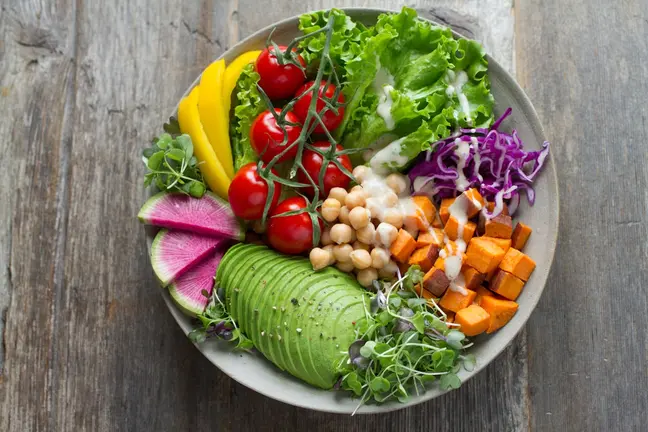
- Whole foods beat isolated protein for most needs. Beans, lentils, eggs, fish, dairy, quinoa, hemp, and lean meat bring fiber, minerals, and other nutrients that a scoop of powder does not. Powder is a convenience, not a requirement.
- Complete versus incomplete matters less than the internet claims. Animal foods and soy carry all nine essential amino acids, most single plants are short one, and eating a normal variety of plants across the day covers the gap without careful "combining" at each meal.
- Spread it out and protect your fiber. Aim for roughly 20 to 40 grams of protein at each of your main meals rather than loading it all at dinner, and do not let a high-protein push crowd out the vegetables, legumes, and whole grains most people already under-eat.
- Past your target, extra protein does little. In healthy people, higher intake does not harm the kidneys, but once your needs are met the surplus offers no special benefit, and strength training does far more for muscle than another shake.
What "high protein" actually means
Protein is one of the three macronutrients, alongside carbohydrate and fat, and the only one that supplies nitrogen. Your body breaks dietary protein into amino acids and uses them to build muscle, enzymes, hormones, antibodies, and the structural material in skin, hair, and bone. Nine of those amino acids are "essential," meaning your body cannot make them and has to get them from food. That is the whole reason protein quality is a real subject rather than marketing.
"High protein" is a loose label, not a legal one. On a package it usually signals a product engineered to carry more grams than its category norm, a bar or a cereal or a pasta reformulated around protein. Applied to a diet, it means an intake above the minimum, skewed toward protein at meals. Federal guidelines set an acceptable range of 10 to 35 percent of daily calories from protein, and most "high protein" eating lands in the upper half of that band. There is no diet-wide requirement to fear either end. What matters is the total over a day and how it is spread, not whether a single food wears the word.
How much protein you need, by age and activity
The baseline comes from the Recommended Dietary Allowance: 0.8 grams of protein per kilogram of body weight per day, set to prevent deficiency in nearly all healthy adults. For a 150-pound (68-kilogram) person that works out to about 55 grams. It is worth being honest that this floor is contested. Some researchers argue the real optimum for active adults and older adults sits higher, while others, including Stanford nutrition scientist Christopher Gardner, point out that the case for a dramatically higher number for the general population is thinner than the trend implies. As Gardner has put it, when you ask what new evidence shows the old target was badly wrong, "there really isn't any." Most Americans, remember, already eat well past the RDA.
Where higher intakes are genuinely justified is more specific. The International Society of Sports Nutrition concludes that 1.4 to 2.0 g/kg per day supports muscle building and maintenance for people who train. Adults over about 60 face a different problem: aging blunts the muscle's response to protein, so guidelines from the PROT-AGE and ESPEN expert groups recommend 1.0 to 1.2 g/kg to help preserve muscle, and 1.2 to 1.5 g/kg during illness or recovery. People losing weight, including those on GLP-1 medications, are often steered toward roughly 1.6 g/kg of adjusted body weight to hold onto muscle while fat comes off. The table below translates those into grams.
| Who you are | Daily target | Grams for a 150-lb (68-kg) adult |
|---|---|---|
| General healthy adult (the floor) | 0.8 g/kg | ~55 g |
| Active, building or keeping muscle | 1.4 to 2.0 g/kg | ~95 to 135 g |
| Older adult preserving muscle (60+) | 1.0 to 1.2 g/kg | ~68 to 82 g |
| Losing weight or on a GLP-1 | ~1.6 g/kg (adjusted weight) | ~90 to 110 g |
One number the daily total hides is per-meal timing. Muscle building responds to a dose of protein, and that dose sits around 0.25 g/kg, or roughly 20 to 40 grams for most adults, ideally repeated every three to four hours. Part of why matters is an amino acid called leucine, the main trigger for muscle protein synthesis; a meal that lands somewhere near 2.5 to 3 grams of leucine flips that switch most reliably. The practical read: a person eating 30 grams of protein at three meals is better set up to build muscle than someone eating the same daily total in one large dinner. You do not need to weigh leucine. You need protein at breakfast and lunch, rather than only at night.
The best whole-food protein sources
Before any powder, this is where most of your protein should come from, because whole foods bring fiber, minerals, and healthy fats along for the ride. The list spans animal and plant on purpose. A mixed eater has the easy path; a plant-based eater needs a bit more volume and variety to reach the same numbers. Serving sizes below are realistic portions, not lab measures.
| Food | Typical serving | Protein | Complete? |
|---|---|---|---|
| Chicken or turkey breast | 3 oz cooked | ~26 g | Yes |
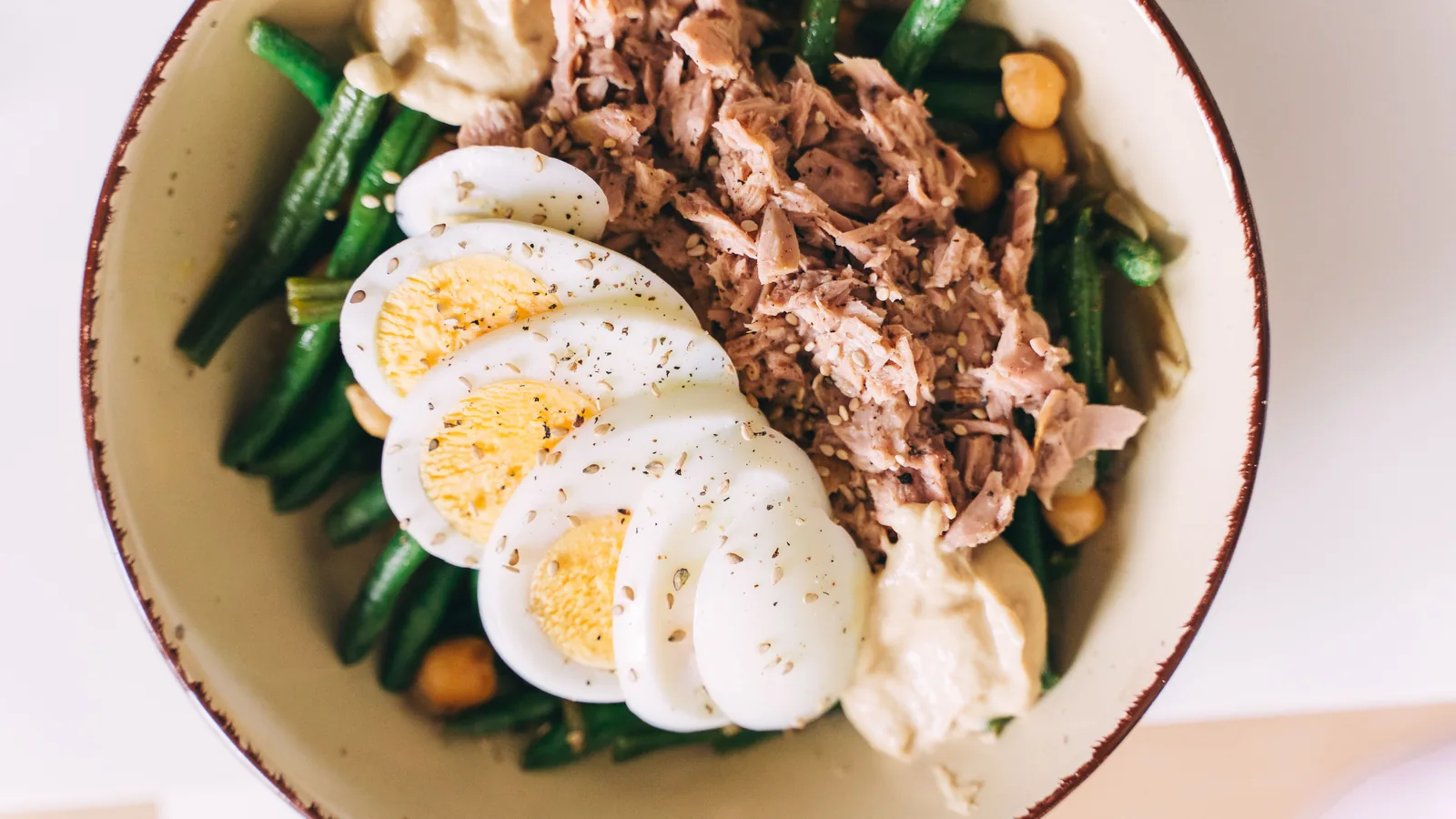
| Canned tuna or salmon | 3 oz | ~20 g | Yes |
| Grass-fed whey powder | 1 scoop | ~20 g | Yes |
| Plain Greek yogurt | 3/4 cup | ~17 g | Yes |
| Cottage cheese | 1/2 cup | ~13 g | Yes |
| Eggs | 2 large | ~12 g | Yes |
| Lentils, cooked | 1 cup | ~18 g | No (low methionine) |
| Edamame, shelled | 1 cup | ~18 g | Yes (soy) |
| Black beans, cooked | 1 cup | ~15 g | No (low methionine) |
| Tempeh | 3 oz | ~16 g | Yes (soy) |
| Tofu, firm | 3 oz | ~8 g | Yes (soy) |
| Hemp hearts | 3 tbsp | ~10 g | Yes |
| Quinoa, cooked | 1 cup | ~8 g | Yes |
| Peanut butter | 2 tbsp | ~8 g | No (low methionine) |
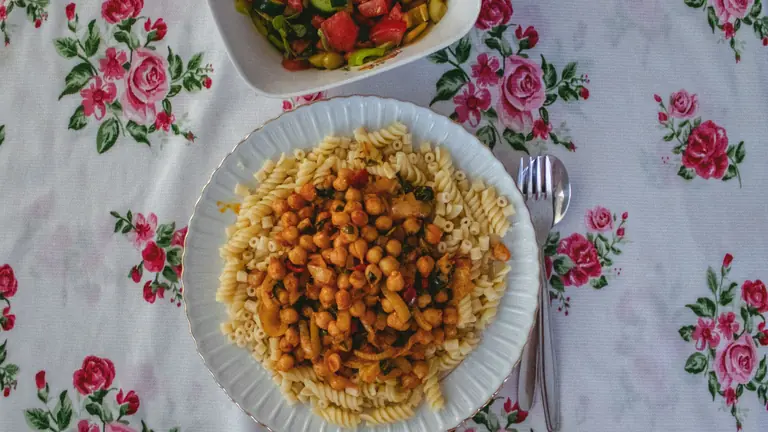
A few of these deserve a note. Hemp hearts are one of the few plant foods that count as complete, and they add about 10 grams of protein to a bowl of oats or a salad with almost no effort. Quinoa is a complete-protein grain that doubles as your starch, so the protein arrives with fiber rather than instead of it. Beans and lentils are the most underrated buy in the store: cheap, shelf-stable, and loaded with fiber alongside their protein. And a legume-based pasta swap turns a low-protein plate into a real one. Ordinary spaghetti brings a few grams; chickpea pasta carries about 20 grams per serving, which we broke down in the high-protein pasta guide. You can browse the full range in the protein and pantry staples section.
Protein quality: complete, incomplete, and why it matters less than you think
Quality describes how well a food's amino acid mix matches what your body needs, and how much of it you actually absorb. A food counts as a complete protein when it carries all nine essential amino acids in useful amounts. Animal foods, soy, and quinoa qualify. Most single plant foods are "incomplete," meaning they run low in one amino acid: grains tend to be short on lysine, beans and lentils on methionine. Scientists rank this with scoring systems. The older PDCAAS, adopted by the FAO in 1993, caps every top protein at 1.0, which flattens real differences. The newer DIAAS measures each amino acid's absorption at the end of the small intestine and can score above 100 percent, which is why it has largely replaced PDCAAS in the research.
Here is the part the "combine your proteins" advice gets wrong. You do not need to pair rice and beans in the same bowl to make a complete protein. Your body maintains a pool of amino acids and draws on it across the day, so eating a normal variety of plants over breakfast, lunch, and dinner covers your essentials without any deliberate matching. At the intakes most people eat, Gardner notes, the amino acid distribution barely matters "because you have so much extra." That is the honest version. Complementary proteins are real biochemistry, but they are a background feature of a varied diet, not a rule you have to manage plate by plate. If you eat entirely plant-based and want the full breakdown, the complete guide to plant-based protein covers sourcing and combinations in depth. For choosing between powders, see our guides to the best plant-based protein powder and what to look for in grass-fed whey.
Protein for satiety, weight, and healthy aging
The strongest everyday case for protein is not muscle, it is fullness. Gram for gram, protein is the most satiating macronutrient, and it carries the highest thermic effect: your body spends more energy digesting protein than it does carbohydrate or fat. A protein-forward breakfast tends to blunt mid-morning hunger better than a carb-heavy one, which is why higher-protein patterns may support weight management, mostly by making it easier to eat less without feeling deprived. That is an association worth using, not a fat-burning trick.
Aging is the other place the payoff is real. Muscle mass starts declining around age 30 and drops faster after 60, on the order of 3 to 8 percent per decade, a process called sarcopenia that quietly erodes strength, balance, and independence. Adequate protein, spread across meals and paired with resistance exercise, is one of the few levers shown to slow it. The honest caveat, and Stanford's researchers are blunt about this, is that the exercise does the heavy lifting. Strength training is what preserves muscle; extra protein supports that work rather than replacing it. If you are eating enough and not lifting, another scoop is not the missing piece. None of this diagnoses, treats, or cures anything. It is ordinary nutrition doing ordinary, useful work, and anyone managing a health condition should run big diet changes past a clinician first.
How to actually hit your target
Turning a number into meals is simpler than the tracking apps suggest. Start with a per-meal anchor of 20 to 40 grams and build the plate around it. Breakfast is where most people fall short, so fix that first: eggs, Greek yogurt, cottage cheese, or a scoop of protein blended into oats moves the morning from near-zero to 25 or 30 grams. Lunch and dinner usually take care of themselves if a real protein source is the centerpiece rather than a garnish. Keep fast options on hand for the gaps. A turkey snack stick, a handful of edamame, or a spoon of hemp hearts each add 10 or more grams without cooking, and we rounded up more portable choices in the high-protein, low-sugar snacks guide. Those shelf-stable options are not interchangeable, and protein density across meat snacks spreads wider than the front of the package suggests.
One trade-off deserves a flag. Chasing protein can quietly push out fiber, and that is a bad swap: only about 5 percent of Americans hit the fiber target as it is. Lean on protein sources that carry fiber with them, the beans, lentils, edamame, quinoa, and hemp above, and you get both at once. The plates to watch are the ones where a bar or a shake replaces a meal that would have included vegetables and whole grains. Whole food first, powder to fill the gap, is the pattern that holds up. It is also worth remembering that many "high protein" packaged products are ultra-processed, so read them the way you would any label rather than trusting the front-of-box number, a habit we make the case for in our piece on ultra-processed foods. For the fiber side of the ledger, the fiber guide is the companion to this one.
Protein myths, corrected
"Too much protein wrecks your kidneys." For healthy people, this is false. A 2018 meta-analysis in The Journal of Nutrition pooled dozens of trials and found that higher-protein diets did not harm kidney function in adults without kidney disease. The rise in filtration rate that older warnings pointed to appears to be a normal adaptation, not damage. The real exception is people who already have chronic kidney disease, who should follow their physician's protein guidance.
"More protein is always better." Only up to a point. Once you meet your target, additional protein gets used for general energy or stored, and it does not add muscle on its own. Beyond your needs, the main cost is opportunity: calories and plate space that could have gone to the fiber-rich foods most people lack.
"You have to eat protein right after a workout." The anabolic window is far wider than the 30-minute rule implied. Total daily protein matters more than precise timing, and the window for post-exercise intake stretches across roughly a day. Getting protein at each meal covers it.
"You need a powder to hit your numbers." No. Powder is a convenient tool, useful for a fast breakfast or a post-gym shake, but a mixed diet of eggs, dairy, fish, meat, beans, and grains reaches any ordinary target without it. Treat supplements as the gap-filler their name implies.
Frequently asked questions
How many grams of protein do I need each day?
The floor is 0.8 grams per kilogram of body weight, about 55 grams for a 150-pound adult. Active people building muscle do better at 1.4 to 2.0 g/kg, and adults over 60 benefit from 1.0 to 1.2 g/kg. Most Americans already exceed the floor, so for many the goal is better sources and better spacing rather than a higher total.
Which foods are highest in protein?
Per serving, the leaders are lean poultry, fish, eggs, Greek yogurt, and cottage cheese, and, on the plant side, lentils, edamame, tofu and tempeh, beans, hemp hearts, and legume-based pastas. Whole foods are preferable to isolated protein because they deliver fiber and micronutrients alongside the grams.
Can I get enough protein on a plant-based diet?
Yes, with a little more volume and variety. Lean on legumes, soy foods, whole grains, nuts, and seeds, and eat a range of them across the day. You do not need to combine specific foods at a single meal; your body pools amino acids over the day. Our plant-based protein guide has the full sourcing plan.
How do I know if I am getting enough protein?
Most healthy adults who eat enough total calories and include a protein source at each meal are already getting enough, which is why true deficiency is rare in the United States. The people most likely to fall short are older adults with small appetites, anyone on a very low-calorie or restrictive diet, and plant-based eaters who do not plan around it. Signs that can accompany a genuine shortfall include ongoing muscle loss or weakness, slow-healing wounds, thinning hair, and constant hunger, though each of those has other causes too. If you are worried, add a protein serving to breakfast and raise it with a clinician rather than self-diagnosing.
Is it better to get protein from food or powder?
Food first. Whole-food protein brings fiber, minerals, and healthy fats that powder lacks. Powder is a fine convenience for a busy morning or after training, but it should fill gaps, not replace meals.
How much protein can my body use at one meal?
For muscle building, roughly 20 to 40 grams per meal covers the useful dose for most adults, and spacing protein across three or four meals works better than one large serving. Your body still absorbs and uses protein beyond that amount, it routes the excess to other jobs rather than extra muscle.
Is a high-protein diet safe long term?
For healthy people, yes. Research does not link higher protein intake to kidney harm in adults without existing kidney disease. The main pitfall is letting protein crowd out fiber-rich plants. Anyone with kidney disease, or who is pregnant or managing a medical condition, should set protein targets with a clinician.
What is a simple high-protein breakfast?
Two eggs with a side of Greek yogurt, or oats stirred with a scoop of protein and a spoon of hemp hearts, each land around 25 to 30 grams. For more ways to make that first meal work, use these high-protein breakfast ideas; fixing breakfast is often the fastest way to raise a daily total because it is where many people start near zero.
The bottom line
Protein is worth the attention it gets, just not always in the direction the trend points. Most people already clear the baseline, so the win is rarely "eat more" in the abstract. It is choosing whole-food sources that bring fiber and nutrients with them, spreading protein across the day instead of stacking it at dinner, and going higher only if you train hard, are past 60, or are losing weight. Build the plate from real food, keep a fast protein or two on hand for the gaps, and let a powder be the backup rather than the plan. Do that and the number takes care of itself, with a better diet as the byproduct.