Mercury in fish is a food-chain story before it is a health story. Tiny organisms take up traces of methylmercury from seawater. Small fish eat a lot of those organisms. Big predators eat a lot of small fish, and they bank a lifetime of mercury in their muscle. A skipjack, caught small and young, sits low on that chain. An albacore, several times its size and years older, sits higher. Where a fish feeds and how long it lived predicts its mercury better than any brand name on the can, and that one idea is the key to eating canned tuna well.
So is canned tuna healthy? For most people, yes. A can is one of the best protein deals in the grocery store: cheap, shelf-stable, and roughly 20 to 26 grams of protein, with no carbohydrate and no sugar. Most healthy adults can eat it regularly without a second thought. The point of this guide is not to scare you off a genuinely good food. It is to show you which species carry more mercury, how much is fine for you specifically, and how to read a can so the one you buy is the better one.
The short version
- Canned tuna is excellent lean protein: 20 to 26 grams per 3-ounce serving, or 30 to 40 grams in a 5-ounce no-drain can, for around 100 to 110 calories a serving with zero carbs and zero sugar.
- Species drives mercury more than brand. Skipjack ("light" tuna) averages about 0.13 ppm; albacore ("white") sits near 0.35 ppm, close to yellowfin; bigeye is the highest and the one to skip.
- The FDA and EPA rank canned light tuna a "Best Choice" (2 to 3 servings a week) and albacore or yellowfin a "Good Choice" (about 1 serving a week). A serving is 4 ounces for an adult, and less for young children.
- Averages hide can-to-can swings. Consumer Reports found occasional cans spiking well above the species average, which is why brands that test every fish add a real margin for pregnancy and kids.
- If omega-3 fats are the goal, sardines (0.8 grams of EPA and DHA per 3 ounces) and canned salmon (0.9) beat light tuna (0.2) at a fraction of the mercury. Use tuna for protein and lean on those two for the fats.
- Read the can for pack (water versus olive oil), sodium, and a BPA-free liner, then match the type to whoever is eating it.
Is canned tuna healthy? What a can actually gives you
The headline number is protein, and it is a strong one. A 3-ounce serving lands around 22 grams for water-packed light tuna and 24 to 26 grams for the denser, no-drain packs, for about 100 to 110 calories; an oil pack runs closer to 130. That is a complete protein with every essential amino acid, which is why a can turns a bowl of greens or a plate of pasta into an actual meal. A whole 5-ounce no-drain can carries 30 to 40 grams, most of the way to the 50-gram Daily Value on its own, and our guide to high-protein foods and how much you need shows where that sits against a real daily target.
The micronutrients are better than tuna's reputation suggests. A 3-ounce serving of light tuna carries about 68 micrograms of selenium, more than a full day's Daily Value, alongside a day's vitamin B12 and 200 milligrams of potassium. Selenium is worth a note because it binds mercury in the body, and researchers are still working out how much that offsets the risk. It is a reason not to panic over a normal serving, not a green light to ignore mercury entirely, so treat it as context rather than a loophole.
Omega-3 fats are where tuna is merely okay rather than great. Water-packed light tuna gives you about 0.2 grams of EPA and DHA per 3-ounce serving in the federal nutrient data. Albacore is the fattier fish and lands near 0.7 grams. The tradeoff there is almost perfectly symmetrical: albacore triples the omega-3 of light tuna, and it triples the mercury too. To get the fats without paying that second half, the answer is a different fish, and we come back to that below.
Mercury, read by species
Because mercury bioaccumulates up the food chain, the useful question is never "does tuna have mercury." All of it does. The question is how much, and the answer tracks the fish. Skipjack, the small tuna that fills most cans labeled "light" or "chunk light," sits low. Albacore, the larger fish sold as "white" tuna, and yellowfin both run roughly two to three times higher. Bigeye, sold mostly as fresh steaks and sushi, is higher still.
The FDA's monitoring data puts hard numbers on it. Here is where the common canned and tinned options fall, alongside the tiers the FDA and EPA use in their Advice About Eating Fish.
| Fish | Average mercury (ppm) | FDA and EPA tier | About how often |
|---|---|---|---|
| Sardines | 0.013 | Best Choice | 2 to 3 servings a week |
| Canned salmon | 0.014 | Best Choice | 2 to 3 servings a week |
| Anchovies | 0.016 | Best Choice | 2 to 3 servings a week |
| Canned light tuna (skipjack) | 0.126 | Best Choice | 2 to 3 servings a week |
| Albacore / white tuna | 0.350 | Good Choice | About 1 serving a week |
| Yellowfin tuna | 0.354 | Good Choice | About 1 serving a week |
| Bigeye tuna | 0.689 | Choice to Avoid | Skip it |
A few things jump out of that table. Canned light tuna, despite its reputation, is a Best Choice you can eat two to three times a week. Albacore is not dangerous, but it earns its one-a-week ceiling. And sardines, salmon, and anchovies sit an order of magnitude lower than any tuna, which is the quiet headline most tuna articles skip. One caveat on the yellowfin row: the FDA lists no separate figure for canned yellowfin, so that 0.354 comes from fresh and frozen samples of the same species. For reference, the FDA's action level, the point at which it can pull a product from commerce, is 1.0 ppm, so every canned tuna above is well under it on average. The word doing the work in that sentence is "average."
Why the species average is not the can in your hand
Species tells you the baseline. It does not tell you what is in the specific can you opened. In 2023, Consumer Reports tested 30 samples across five canned-tuna brands and found that mercury levels jumped around far more than the tidy averages suggest. About one in five cans carried a spike high enough to change the FDA's advice on how often that particular can should be eaten. Their food-safety lead put it plainly: from can to can, mercury can spike in unpredictable ways that matter most for a developing fetus. On the strength of that variability, Consumer Reports went further than the federal advice and told pregnant readers to skip canned tuna entirely. The FDA and EPA still allow it inside the tiers above, and knowing that a testing group and a regulator read the same data differently is part of making your own call.
This is the gap between a chart and a purchase. An average is built from thousands of fish, but you buy one at a time, and tuna is a wild animal whose mercury depends on its individual size, age, and diet. For a healthy adult eating tuna a couple of times a week, the occasional high can washes out over time, and that is a measurable process rather than a comforting phrase: methylmercury clears the blood on a half-life of roughly 50 days, though the rate varies a good deal between people. That is why federal advice counts servings per week instead of treating a single can as permanent. For someone who is pregnant, or feeding a toddler, the individual can is the thing that counts, because the exposure that matters lands on a developing nervous system in a narrow window.
That is the real reason per-fish testing exists. Most canners test a small sample of a batch and publish the batch average. One brand we carry, Safe Catch, tests every single fish and rejects any that exceed its posted limit, which it sets well below the FDA's. Its skipjack Elite line holds to a 0.1 ppm limit, ten times stricter than the FDA action level, and the company says roughly one in four tuna fail that bar and get turned away. The claim survives outside scrutiny: the BBB's National Advertising Division reviewed it and found the "every tuna tested" and "lowest mercury" positioning substantiated.
That same review also told the company to drop a graphic implying rival brands are dangerous, which was the right call, because the case for per-fish testing rests on variance rather than on any other brand being unsafe. Testing every fish does not lower the species average. It trims the high tail, which is exactly the part that matters for the most sensitive eaters.
Worth being honest about the shelf here. Most canned tuna, including most of what we stock, is albacore or yellowfin, which are Good Choice fish at roughly one serving a week. The one Best Choice tuna on our shelf is the skipjack Elite. If you are buying tuna for a pregnancy or for young kids, that distinction, plus the every-fish testing, is the whole ballgame.
How much is safe, and for whom
Federal advice is built around servings, and a serving is smaller than most people assume. For an adult, one serving is 4 ounces, about the size of your palm, or a little under one standard 5-ounce can. From there the math is simple:
- Most adults: canned light tuna is a Best Choice at 2 to 3 servings a week. Albacore and yellowfin are Good Choices at about 1 serving a week. That assumes tuna is your fish for the week; if you also had salmon, count it toward the total.
- Pregnant or breastfeeding: the same tiers apply, and this is the group the advice is written for. Light tuna up to 2 to 3 servings a week; albacore held to 1. When in doubt, choose skipjack, or a brand that tests every fish, and talk it through with your clinician.
- Children ages 1 to 11: servings scale with age. The FDA suggests about 1 ounce at ages 1 to 3, 2 ounces at 4 to 7, 3 ounces at 8 to 10, and 4 ounces at 11, with roughly 2 servings of Best Choice fish a week.
Tuna is a food to portion, not one to fear. A person who eats a tuna sandwich on light tuna twice a week is squarely inside the guidance. The people who need to watch the type and the count are the ones growing a brain, whether their own in the womb or their child's at the dinner table. If you have a health condition or take medication that raises the stakes, treat this as general information and check with a healthcare professional.
How to read a can of tuna
With the species and the serving settled, the label handles everything else. Four things are worth a glance before it goes in the cart.
Pack: water, olive oil, or other oil
The packing liquid changes what you get. Water-packed tuna keeps more of the fish's own omega-3 fats, because when you drain oil-packed tuna, some of those fats pour off with the oil. In the federal nutrient tables the gap is close to half: 0.23 grams of EPA and DHA in 3 ounces of drained water-packed light tuna against 0.11 grams in the drained oil-packed version. That surprises people who assume oil means more good fat. The exception is tuna packed in a quality olive oil that you actually use, in a dressing or over pasta, where the oil is a feature rather than something to discard. What you want to avoid is tuna packed in a refined soybean or "vegetable" oil you are just going to drain. Our spring-water and olive-oil Tonnino packs are the two ends of that choice.
Sodium
Canned tuna runs from 25 mg of sodium in a no-salt-added can up to 300 mg in a salted one, and the packing liquid is not what decides it: a no-drain can packed with sea salt can carry more sodium than an oil pack. For frequent eaters, or anyone watching blood pressure, a no-salt-added can lets you season it yourself and control the total.
Liner
The can's inner coating matters more than it sounds. Many older cans used a BPA-based epoxy liner, and BPA is something plenty of shoppers now prefer to avoid. Look for "BPA-free" or "BPA-NI" (non-intent) on the can. It is a small check that rules out a common concern.
Ingredients and sourcing
The best canned tuna has a two-line ingredient list: tuna and salt, or tuna alone. Skip anything with added broths, fillers, or flavor blends you did not ask for. On the sustainability side, a Marine Stewardship Council (MSC) mark, a Monterey Bay Aquarium Seafood Watch nod, or "dolphin-safe" and pole-and-line language all point to better-managed fisheries.
Here is how the tuna we stock compares on the axes you actually weigh, normalized to a 3-ounce serving so the numbers line up.
| Product | Species (FDA tier) | Packed in | Protein / 3 oz | Sodium / 3 oz |
|---|---|---|---|---|
| Safe Catch Elite | Skipjack (Best) | No drain, sea salt | 24 g | 300 mg |
| Safe Catch Ahi Yellowfin | Yellowfin (Good) | No drain, sea salt | 26 g | 220 mg |
| Safe Catch Wild Albacore | Albacore (Good) | No drain, sea salt | 22 g | 115 mg |
| Safe Catch Albacore, No Salt | Albacore (Good) | No drain, no salt | 22 g | 25 mg |
| Tonnino Yellowfin, Spring Water | Yellowfin (Good) | Spring water | 16 g* | 160 mg* |
| Tonnino Yellowfin, Olive Oil | Yellowfin (Good) | Olive oil | 20 g | 270 mg |
Two patterns are worth calling out. The no-drain packs read higher on protein because nothing gets poured off, so every gram of fish stays in the can. And sodium tracks the pack rather than the fish: the same albacore runs 115 mg salted or 25 mg unsalted, while the skipjack Elite, the lowest-mercury can in the group, carries the most sodium of the six. Species and salt are separate decisions, and the no-salt can hands you the dial on the second one. (The Tonnino figures marked with an asterisk are converted from that label's larger 3.7-ounce serving to match the 3-ounce basis of the rest, which is why they read lower per ounce than the no-drain cans above them.)
If you are really after omega-3s, look past tuna
Tuna gets shopped as a health food partly on its omega-3 reputation, and that reputation belongs to other fish. Per 3-ounce serving, sardines deliver 0.8 grams of EPA and DHA and canned salmon 0.9, against 0.2 for light tuna. Albacore closes most of that gap at 0.7, but it buys the fats with something like 25 times the mercury of a sardine, which is a poor exchange when the sardines are sitting on the same shelf. Atlantic mackerel is another omega-3-rich, low-mercury tin worth a spot in the rotation, though not king mackerel, which is high in mercury and on the avoid list.
All of those fish rank low for mercury, sardines and salmon near the very bottom of the table above, so you get more of the fats with less of the metal. The tinned-fish trend that took off in recent years rests on exactly this: sardines, anchovies, mackerel, smoked trout, and mussels are the tastiest tins and the smartest ones at the same time. It is the rare case where the cheaper, humbler can wins on both counts.
None of that dethrones tuna. It just clarifies the jobs. Use tuna as an affordable, low-calorie protein you can eat a few times a week. When the goal is specifically omega-3s for heart or brain, reach for sardines or salmon, or read our deeper dives on omega-3 fatty acids and choosing a fish-oil supplement when food alone is not getting you there.
Easy ways to eat it well
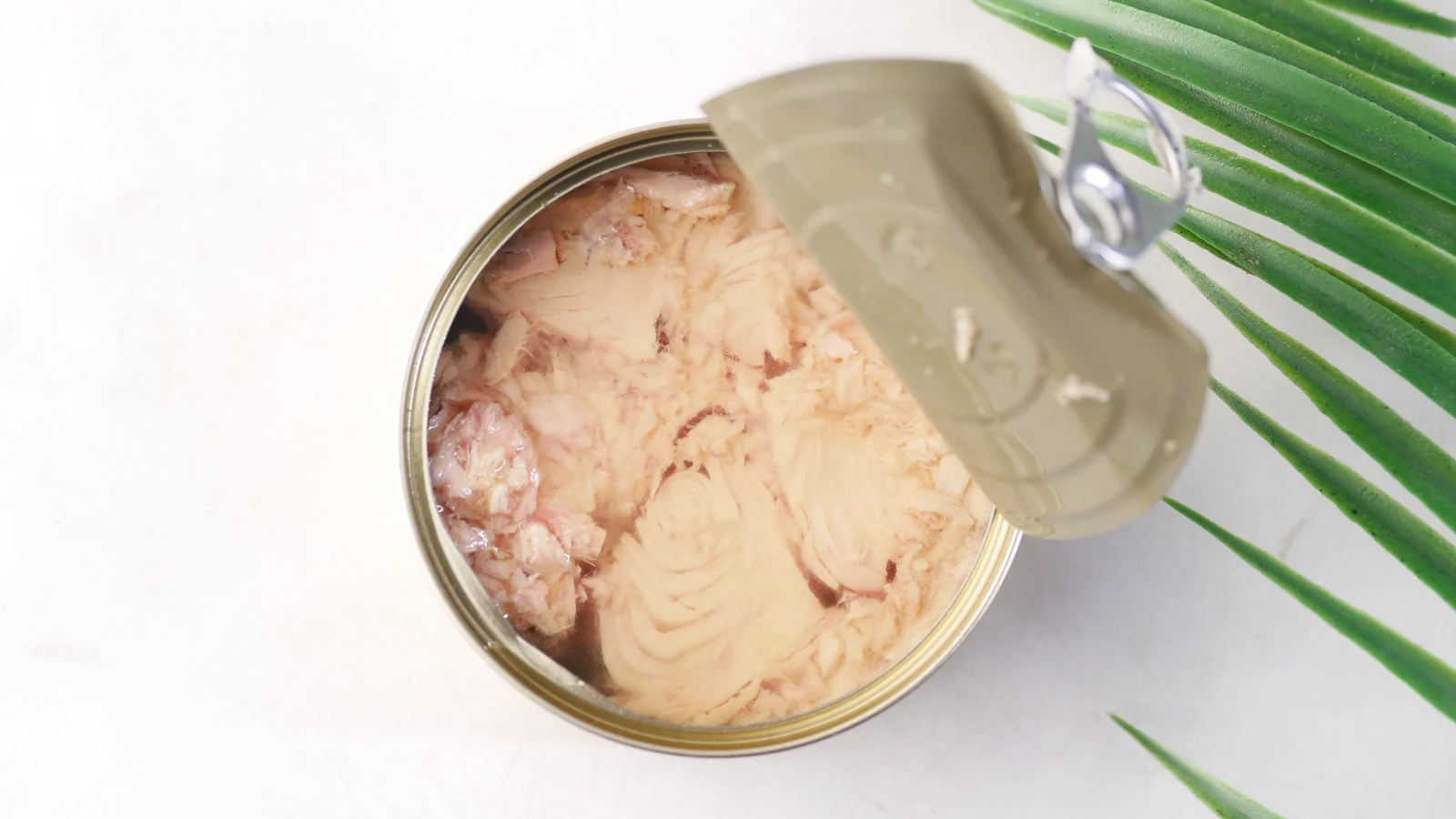
The fastest way to ruin a good can of tuna is to bury it in mayonnaise. A better move: flake it over greens with olive oil and lemon, fold it into a grain bowl, stir it through warm pasta with garlic and chili, or pile it on whole-grain toast with sliced tomato. A no-drain can needs nothing poured off and brings its own moisture, so it works straight from the tin. Drain a water or oil pack first, unless you are using a quality olive oil in the dish.
As a budget protein it is hard to beat. A single can carries 30 to 40 grams of protein and keeps in the pantry for years, a cost per gram that fresh fish cannot come near. That makes it a natural teammate to the other shelf-stable proteins in our high-protein, low-sugar snack picks, and a reliable answer to the weeknight "what is actually in the cupboard" problem. Keep a few cans across species, a light for everyday and a no-salt albacore for when you want to season it yourself, and you have covered most of the week.
Frequently asked questions
Is canned tuna healthy to eat every day?
For most adults, a few times a week is a better rhythm than daily, mostly because of mercury rather than the tuna itself. If you eat it daily, make it canned light (skipjack), which the FDA rates a Best Choice, and rotate in other proteins and lower-mercury fish like salmon and sardines across the week.
Which canned tuna has the least mercury?
Skipjack, sold as "light" or "chunk light," averages about 0.13 ppm, roughly a third of albacore's 0.35. Beyond species, a brand that tests every fish trims the occasional high can that a species average hides, which matters most for pregnancy and young children.
Is light tuna or albacore better?
It depends on the goal. Light tuna (skipjack) is lower in mercury and fine 2 to 3 times a week. Albacore is the fattier fish and carries triple the omega-3, but it pays for that with triple the mercury, so the FDA holds it to one serving a week. For frequent eaters and sensitive groups, light wins.
How much protein is in a can of tuna?
A standard 5-ounce no-drain can holds 30 to 40 grams of protein, since the 3-ounce serving on the panel runs 22 to 26 grams and the can holds a little over one and a half servings. A water-packed can lands lower once drained. Either way, one can covers most of the 50-gram Daily Value for protein.
How much canned tuna is safe during pregnancy?
The FDA and EPA advice covers pregnancy directly: canned light tuna up to 2 to 3 servings (4 ounces each) a week, and albacore or yellowfin limited to about one. Choosing skipjack, or a brand that tests every fish for mercury, adds margin. Confirm your own plan with your clinician.
Is tuna in water or oil better?
Water-packed keeps more of the fish's own omega-3 fats, because draining oil-packed tuna pours some of those fats off with the oil. The exception is tuna in a good olive oil you actually use in the dish. Refined soybean or "vegetable" oil you are going to drain adds little.
Does canned tuna have omega-3s?
Some, but tuna is not an omega-3 powerhouse: about 0.2 grams of EPA and DHA per 3-ounce serving of light tuna, and 0.7 for albacore, which carries triple the mercury to match. Sardines and canned salmon deliver four to five times what light tuna does with a fraction of the mercury, so use those when the fats are the point.
How long does mercury from tuna stay in your body?
Methylmercury clears the blood on a half-life of roughly 50 days, so exposure from one meal falls off over weeks rather than lodging permanently, and elimination speed varies quite a bit from person to person. That is the reasoning behind weekly serving limits instead of lifetime tallies. If you have been eating high-mercury fish heavily, easing back to Best Choice species is the practical step, and anyone pregnant or worried about a specific exposure should raise it with a clinician rather than self-testing.
Is canned tuna good for weight loss?
It fits the pattern well: 3 ounces gives 22 to 26 grams of protein for around 100 calories with no carbohydrate, and protein is the most filling of the three macronutrients. Choose water or no-drain packs over oil if calories are the constraint, and skip drowning it in mayonnaise, which can add more calories than the fish itself carries.
Can kids eat canned tuna?
Yes, in age-scaled portions. Federal guidance suggests about 1 ounce at ages 1 to 3, 2 ounces at 4 to 7, 3 ounces at 8 to 10, and 4 ounces at 11, with roughly two servings of Best Choice fish a week. Lean on light tuna over albacore for kids, and every-fish-tested brands add a safety margin.
How long does canned tuna last, unopened and once opened?
Unopened, a can holds its quality for 3 to 5 years in a cool, dry pantry, and the date stamped on the lid is a quality date rather than a safety cutoff. Once you open it, move the leftovers out of the can into a covered container and refrigerate them; federal storage guidance gives opened canned fish 3 to 4 days. Throw out any can that is bulging, leaking, deeply dented on a seam, or rusted through.
Is canned tuna already cooked?
Yes. The fish is cooked inside the sealed can during processing, which is what makes it shelf-stable, so nothing more is needed before you eat it. Flake it straight into a salad or a bowl, or warm it through when the dish calls for it.
What is the difference between chunk light and white tuna?
Both are real, whole tuna, just different species. "Light" or "chunk light" is usually skipjack, a small, lower-mercury fish; "white" tuna is albacore, larger, firmer, paler, and higher in mercury. "Solid" versus "chunk" refers to the cut rather than the species: solid packs hold bigger pieces, chunk is more broken up. For frequent eating, chunk light is the lower-mercury pick.
Is canned tuna sustainable and dolphin-safe?
It varies by fishery and catch method. A Marine Stewardship Council (MSC) mark, a Monterey Bay Aquarium Seafood Watch recommendation, or pole-and-line and "dolphin-safe" labeling all point to better-managed sources. Skipjack caught by pole-and-line or FAD-free methods is generally the more sustainable choice.
The bottom line
Canned tuna earns its place in the pantry: cheap, lasting, and genuinely high in protein. Mercury is a real consideration, not a reason to avoid it. Read the species first, since skipjack light tuna is a low-mercury Best Choice and albacore is a once-a-week Good Choice. Match the count to who is eating, watch the pack and the sodium, and when omega-3s are the goal, let sardines and salmon do that job. Buy the better can and tuna stays what it should be: one of the easiest good meals in the house. Browse our canned seafood to compare the options side by side.