The oldest surgical manual we have, an Egyptian scroll copied around 1600 BCE and known as the Edwin Smith Papyrus, prescribes honey for wounds more than five hundred times. Sumerian clay tablets did the same three centuries earlier. For most of recorded history honey was less a sweetener than a medicine, smeared on burns and battle wounds because it worked, long before anyone could say why. That instinct never fully disappeared. Walk into a modern burn unit and you may still find honey on the shelf, now purified and packed into sterile dressings, treating the same injuries it treated four thousand years ago.
The rest of the story is messier than the folklore suggests. Some of what honey is credited with holds up under study, some of it does not, and much of what sits on grocery shelves is not the food the label implies. This guide sorts the main types of honey, explains what manuka, raw, and organic actually mean, weighs the evidence honestly, and shows you how to tell real honey from an expensive jar of filtered syrup.
What to know up front
- Honey is nectar that bees have chemically rebuilt. Enzymes, low water content, and natural acidity make it so hostile to microbes that sealed honey never spoils, which is also the root of most of its studied benefits.
- The type matters more for flavor than for health. Clover is mild, buckwheat is dark and richest in antioxidants, wildflower shifts with the season, and manuka is the specialty grade sold for its antibacterial strength.
- "Pure" means nothing on a label; "raw" and certified origin mean a lot. Among the most adulterated foods in the world, honey often reaches the shelf ultrafiltered until the pollen that proves its origin is gone.
- Manuka is graded by UMF or MGO. MGO measures one antibacterial compound; UMF is a broader authenticity system. Higher numbers cost more and suit wound care and sore throats, not your morning toast.
- Honey still counts as sugar. It carries trace antioxidants and a gentler glycemic hit than table sugar, but it counts as added sugar and should be used sparingly. Never give it to a baby under one year old.
What honey actually is
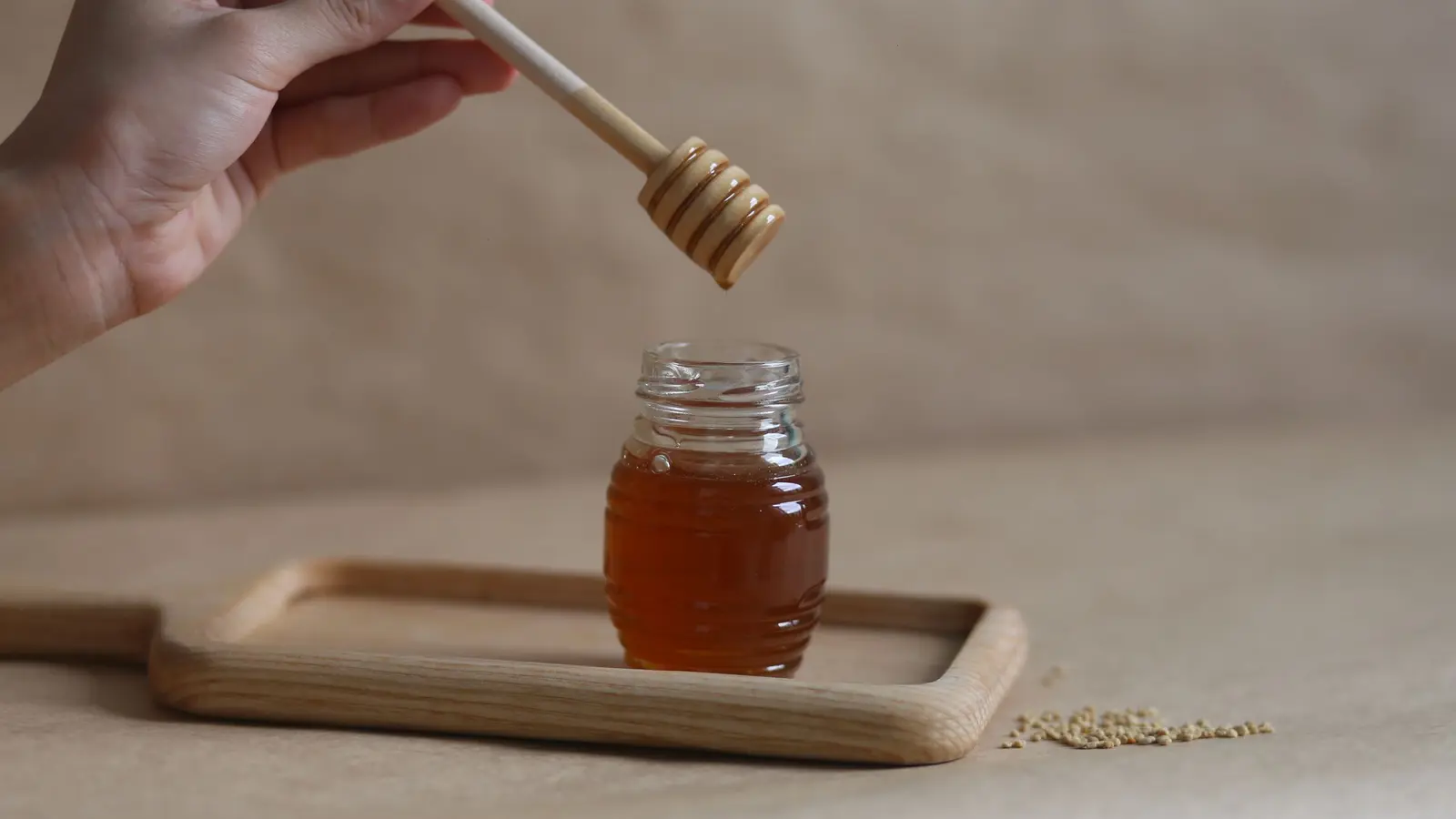
Honey starts as flower nectar, a thin sugar-water that foraging bees collect and pass mouth to mouth back at the hive. Along the way an enzyme called invertase splits the nectar's sucrose into glucose and fructose, and a second enzyme, glucose oxidase, primes the honey to release small amounts of hydrogen peroxide. The bees then fan the combs with their wings until the water content drops below about 18 percent. What they seal into the wax is a completely different substance from the nectar they gathered.
That finished chemistry is unusually hostile to life. Honey holds so little free water and sits acidic enough, around pH 3.9, that bacteria and mold cannot grow in it. Add the trickle of hydrogen peroxide, and you have a food that preserves itself indefinitely. Archaeologists have opened sealed jars in Egyptian tombs and found the honey inside still edible after three thousand years. Nothing about that is marketing; it is the same set of properties that let ancient healers pack a wound with honey and watch it resist infection.
Everything worth knowing about honey's benefits traces back to those four traits working together: high sugar concentration, low water, acidity, and peroxide. Strip them away with heat or heavy filtration and you are left with something closer to flavored syrup.
The label problem most guides skip
Here is the part the recipe blogs leave out. Few foods on the planet are faked as often as honey, and the fraud is industrial in scale. A widely cited 2011 investigation of honey bought from American grocery stores, drugstores, and big-box chains found that roughly three-quarters of it contained no pollen at all, the telltale sign of ultrafiltration. A 2023 European Commission operation tested imported honey and flagged nearly half the samples as suspected of adulteration, usually with cheap rice or beet syrup.
Two things are happening. The first is dilution, cutting real honey with high-fructose corn syrup or rice syrup to stretch a cheap product cheaper. The second is ultrafiltration, forcing honey through fine filters under pressure to remove every trace of pollen. Filtration is not fraud by itself, but pollen is honey's fingerprint, the only way a lab can verify what flowers it came from and what country produced it. Remove the pollen and the trail goes cold, which is exactly why launderers of mislabeled honey do it.
The label words that sound reassuring are the ones to distrust. "Pure" and "natural" have no legal definition for honey and tell you nothing. The words that carry weight are different:
- Raw means the honey was not heated past hive temperature or finely filtered, so its enzymes, pollen, and antioxidants survive. That is the version worth buying.
- Organic, carrying the USDA seal, certifies the beekeeping and the forage area, though genuinely organic honey is hard to guarantee because bees range for miles.
- True Source Certified is an independent audit of the supply chain that verifies where the honey actually came from.
- A single, specific country of origin beats a vague "blend of honeys from more than one country," which is packaging language for untraceable.
You can even run a rough check at home. Real raw honey clouds and crystallizes over months; that is normal and reversible with gentle warmth. Honey that stays glass-clear and perfectly pouring for years has usually been filtered and heated hard. Our guide to spotting ultra-processed foods covers the same instinct applied across the grocery store: the shorter and more honest the ingredient list, the better.
The main types of honey, decoded
Every honey takes its character from the flowers the bees worked. A single-source honey like clover or orange blossom comes mostly from one bloom; wildflower honey is a snapshot of whatever was flowering nearby. Color is a quick proxy for intensity and antioxidant content: the darker the honey, the bolder the flavor and, generally, the higher the antioxidant load.
| Variety | Color and flavor | Best for | Worth knowing |
|---|---|---|---|
| Clover | Light, mild, gently floral | Everyday sweetening, tea, baking | The default supermarket honey; inoffensive and versatile |
| Wildflower | Amber, variable, changes by season and region | Table honey with more character than clover | Local wildflower honey is the kind often tried for seasonal pollen exposure |
| Orange blossom | Light, citrusy, fragrant | Drizzling, dressings, yogurt | A single-source honey with a distinct fruit note |
| Buckwheat | Very dark, malty, almost molasses-like | Marinades, strong teas, spooning for a cough | Highest in antioxidants of the common types, by a wide margin |
| Manuka | Dark, thick, earthy | Sore throats, topical and wound use, specialty | Graded for antibacterial strength; the priciest honey by far |
| Hot honey | Honey infused with chili heat | Pizza, fried chicken, cheese, roasted vegetables | The breakout culinary trend; a condiment, not a health product |
Variety is only half the label. Honey also comes in different forms: liquid (the familiar pourable jar), raw (unheated and unfiltered), creamed or whipped (deliberately crystallized to a smooth, spreadable set), comb (sold still in the edible beeswax comb), and infused like hot honey. Form is about texture and processing; variety is about the flower. A jar can be both, as in a raw wildflower honey. For most kitchens the choice comes down to flavor and use, not a benefits ranking. A mild clover or a local raw wildflower honey handles nearly everything you would want honey to do. Reach for buckwheat when you want depth or the highest antioxidant content, and treat hot honey as what it is: a genuinely good condiment riding a wave of popularity, with no special nutrition beyond the honey it starts from.
Manuka honey, and what UMF and MGO really mean
Manuka is the honey people search for most, and the one surrounded by the most marketing. It comes from bees that forage the manuka bush in New Zealand and parts of Australia. What sets it apart is an unusually high and stable level of methylglyoxal, or MGO, a compound with antibacterial activity that does not depend on the fragile hydrogen peroxide most honeys rely on. That stability is why hospitals use medical-grade manuka in wound dressings.
Because manuka commands premium prices, it is also heavily counterfeited, which is why two grading systems exist to prove a jar is the real thing.
| Rating | What it measures | How to read it | Rough equivalents |
|---|---|---|---|
| MGO | Methylglyoxal concentration, in milligrams per kilogram | A direct number for antibacterial potency; higher is stronger | MGO 100+ is entry level; 250+ and 400+ are common mid-to-high grades; 550+ is potent |
| UMF | A composite authenticity grade checking MGO, leptosperin, DHA, and HMF | Verifies the honey is genuine manuka, not only how strong it is | UMF 5 to 10 is everyday; 15+ is therapeutic; 20+ is rare and expensive |
The practical translation: MGO tells you how much of the active compound is present, while UMF also confirms the honey is authentic manuka. Neither converts cleanly into the other, so compare like with like. A low grade around MGO 100 or UMF 5 is fine for daily sore-throat use; the high grades are aimed at topical and wound applications and rarely justify their cost for eating. Spreading UMF 20 manuka on toast is like using a prescription cream as hand lotion. It is worth knowing, too, that you do not need manuka to get honey's everyday benefits, and we do not stock it, because the raw and organic honeys we carry cover ordinary kitchen and sore-throat use at a fraction of the price.
What the science supports, and what it doesn't
Honey has a real evidence base, narrower than the wellness copy claims but broader than the skeptics allow. The strongest findings are these.
Cough in children. This is honey's best-supported use. Reviews of controlled trials find that a spoonful of honey at bedtime may ease nighttime coughing and improve sleep in children over one year old, performing about as well as common over-the-counter cough remedies and better than no treatment. It is cheap, and it sidesteps cough syrups that carry their own cautions for kids. It also earns honey a place in the seasonal toolkit alongside the habits in our guide to building a resilient immune system. The hard limit: never for infants under twelve months.
Wound and burn care. Clinical reviews report that honey, especially medical-grade manuka applied by a clinician, may speed healing of minor burns and some wounds through its antibacterial and moisture-holding action. That is the modern echo of the Egyptian practice. It refers to sterile medical honey used under guidance, not the jar in your pantry smeared on a cut at home.
Antioxidants and throat soothing. Honey carries polyphenols and flavonoids, and darker varieties like buckwheat contain far more of them, by some measures many times the antioxidant capacity of pale honeys. Those compounds are associated with anti-inflammatory activity, part of the same food-first thinking behind our anti-inflammatory diet guide, and part of why honey coats and calms a raw throat. If antioxidants are your reason for reaching for honey, our overview of which antioxidants actually matter puts honey's contribution in context; it is a pleasant addition, not a primary source.
Where the evidence thins out is the sweeping stuff: honey as a weight-loss aid, an allergy cure, or a detox. The popular idea that local honey desensitizes seasonal allergies is intuitive but poorly supported by trials, since the pollen that triggers hay fever is windborne grass and tree pollen, not the flower pollen bees collect. Treat it as food with some useful properties, not a treatment. Keep that frame and it earns its place; stretch it and you are buying folklore.
Honey versus sugar: is it actually healthier?
This is the question behind most honey searches, and the honest answer has two halves. Honey is nutritionally richer than white sugar, and it is still sugar.
Chemically both are built from glucose and fructose. Table sugar is those two bound together in equal measure with nothing else; honey is a free mix of the same sugars plus water, trace enzymes, antioxidants, and tiny amounts of vitamins and minerals. Honey's glycemic index typically lands somewhere in the 35 to 60 range depending on the variety, below table sugar's 60-to-65, so it tends to raise blood sugar somewhat more gently. By taste it is sweeter, so you can often use a little less.
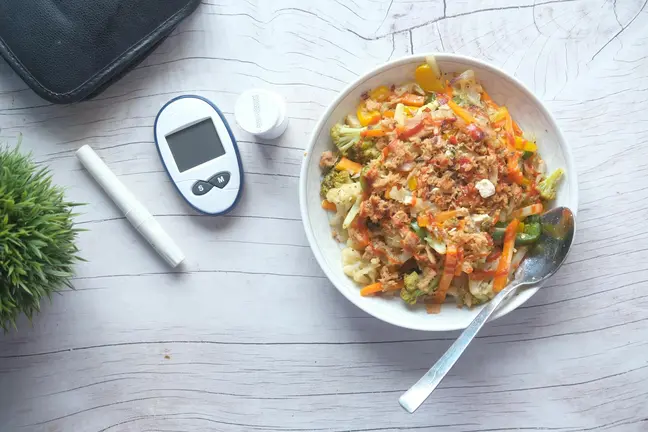
None of that makes honey a health food. A tablespoon of honey has about 64 calories to table sugar's 49, and your body still processes it as added sugar. The trace nutrients are real but small; you would have to eat an unreasonable amount to make them count, at which point the sugar load undoes any benefit. If you are managing blood sugar, honey is not a free pass, and the gentler glycemic response does not exempt it from the daily added-sugar budget. Our guide to keeping blood sugar steady treats all added sugars the same way, honey included. The reasonable takeaway: if you are going to sweeten something, a quality raw honey is a slightly better and far more flavorful choice than refined sugar. Use it as a seasoning, not a staple.
Who should be careful with honey
Honey is safe for most people, with a few firm exceptions worth stating plainly.
- Babies under one year: never. Honey can carry Clostridium botulinum spores that a mature gut neutralizes but an infant's cannot, and those spores can cause infant botulism, a serious illness. This is not a caution to weigh; it is a rule. No honey in food, on a pacifier, or to soothe a cough before the first birthday.
- People managing diabetes or blood sugar. Honey raises blood glucose. The gentler glycemic index does not change the need to count it as sugar and dose accordingly.
- Anyone with a known allergy to bee products or specific pollens should introduce a new honey cautiously.
- Calorie awareness. Honey packs a lot of energy into a small amount. It belongs in the same mental bucket as any added sweetener.
As with any change that touches a medical condition, medication, or pregnancy, talk it through with a healthcare professional rather than relying on a food's reputation.
How to choose and store honey
Buying well comes down to a few habits. Favor honey labeled raw, ideally with a single, named country or region of origin, and treat certifications like USDA Organic or True Source as tiebreakers that signal a traceable supply chain. Let the color guide flavor: pale for mild, dark for bold and antioxidant-rich. Skip anything whose only selling words are "pure" and "natural" with no origin behind them.
Store honey at room temperature with the lid closed, away from heat. It does not need refrigeration, and cold actually speeds crystallization. When honey turns grainy or solid, it has not gone bad; that is genuine honey doing what genuine honey does. Set the jar in a bowl of warm water and stir, and it returns to liquid without harm. Avoid the microwave, which overheats the honey and destroys the very enzymes you paid for.
If you want a straightforward starting point, a raw, unfiltered honey from a single origin is the most versatile jar in any kitchen, good in tea, on toast, in dressings, and by the spoon when a scratchy throat sets in. The honeys we stock are chosen on exactly those terms: raw or organic, single-ingredient, and honestly labeled. You can browse the full range on our honey shelf.
Frequently asked questions
Is raw honey better than regular honey?
For most purposes, yes. Raw honey skips the high heat and fine filtration that strip out pollen, enzymes, and antioxidants, so it keeps more of what makes honey worth eating. Regular commercial honey is safe and fine for baking, but it is often the more processed product. If the label does not say raw, assume it has been heated and filtered.
Does honey ever go bad or expire?
Sealed and stored properly, honey does not spoil; its chemistry prevents microbial growth almost indefinitely. It may darken, thicken, or crystallize over time, but none of that means it has gone off. Warm it gently to bring it back. Discard it only if water got in and it began to ferment, which smells and tastes sour.
Is manuka honey worth the price?
For everyday sweetening, no; a good raw honey does the same job for far less. Manuka earns its cost only if you specifically want its higher, more stable antibacterial activity for sore throats or, under a clinician's guidance, topical use. If you buy it, buy a certified UMF or MGO grade so you know it is genuine.
Can honey help a cough or sore throat?
It may. Controlled trials support a spoonful of honey for easing nighttime cough in children over one year old, roughly on par with over-the-counter options, and its coating, anti-inflammatory quality soothes an irritated throat in adults too. A spoonful is a reasonable first step for a mild cough, though never for infants under one.
Is honey safe for people with diabetes?
In small amounts and counted as sugar, honey is not off-limits, but it is not a free substitute either. It raises blood glucose much like sugar does, if slightly more gently. Anyone managing diabetes should treat honey as part of the daily sugar budget and coordinate with their care team.
Is honey vegan?
Strictly, no. Honey is made by bees, so most vegans avoid it along with other animal-derived foods, and many choose plant sweeteners like maple syrup, date syrup, or agave instead. Vegetarians who eat other animal products generally include honey. If you avoid animal foods for ethical reasons, honey is usually off the list.
Is honey good for your skin?
It may help in specific ways. Honey holds moisture and has mild antibacterial activity, which is why it appears in cleansers and masks and why medical-grade honey is used on wounds under supervision. For everyday skincare it can be a gentle addition, but it is not a substitute for treatment of a skin condition; see a professional for anything persistent.
Why does my honey turn solid or grainy?
Crystallization is natural and, if anything, a sign of real, minimally processed honey. Glucose separates out of the liquid over time, faster in the cold. It is completely edible; warm the jar in a bowl of hot water and stir to reliquefy. Honey that never crystallizes has usually been heavily filtered.
How can I tell if my honey is fake?
Start with the label: distrust "pure" and "natural" with no origin, and favor raw honey from a single named country with a certification like True Source. Real honey clouds and crystallizes over months; honey that stays perfectly clear and liquid for years has likely been ultrafiltered. The only definitive test is lab analysis, so buying from transparent, traceable sources is your best everyday safeguard.
The bottom line
Honey is one of the few foods that has kept a genuine place in both the kitchen and the medicine cabinet for four thousand years, and the reason is chemistry, not magic. Buy it raw and traceable, match the variety to how you will use it, respect the one hard rule about infants, and remember that even the best honey is still sugar to be enjoyed in moderation. Do that, and you get the real thing: a flavorful, minimally processed sweetener with a few honestly useful properties, and none of the story you were sold on a filtered plastic bear.
The information here is meant to inform, not to replace a conversation with your own clinician. Check with a qualified healthcare professional before leaning on any food or supplement for a health concern, particularly during pregnancy or breastfeeding, alongside a medical condition, or when caring for a young child.