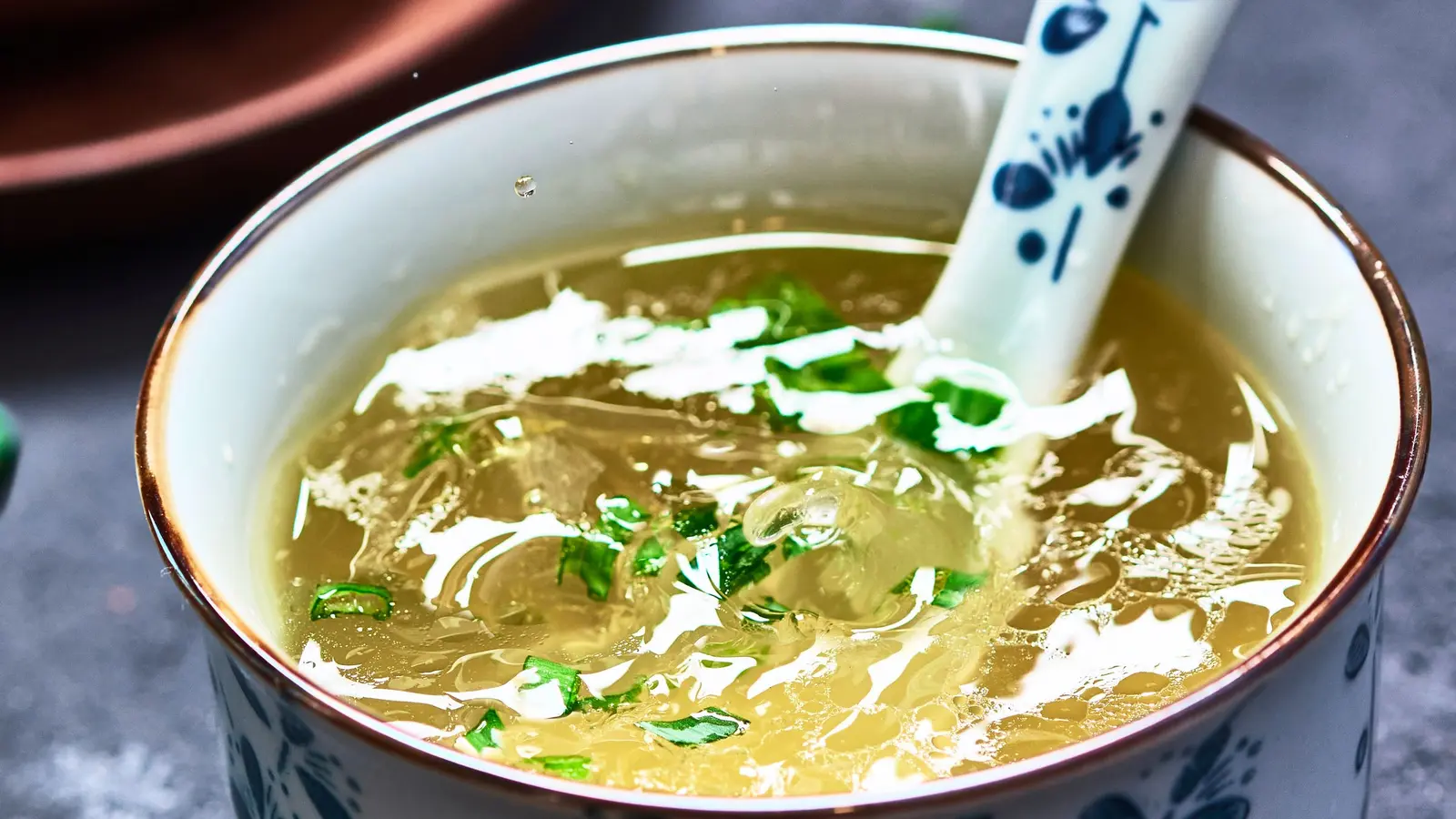
Chill a pot of real bone broth overnight and it stops behaving like soup. It sets into a soft, wobbling gel you can scoop with a spoon. That jiggle is the whole story in one image: hours of low simmering pull collagen out of bones and connective tissue, and as the broth cools, that collagen turns to gelatin and firms up. The wobble is the most honest thing bone broth does, and the source of most confusion about what it does for you.
Bone broth is genuinely nourishing and worth keeping in the fridge. It also gets sold with promises it cannot keep. The real bone broth benefits are narrower and more specific than the packaging suggests, so this guide separates the two, with the protein numbers, the collagen reality, the sodium and lead figures you will actually meet on the shelf, and a straight answer on homemade versus the carton.
The short version
- A cup of bone broth delivers roughly 6 to 12 grams of protein, closer to a light snack than a protein shake, and it is an incomplete protein that runs low in tryptophan.
- The collagen in broth is real, but eating collagen does not route it to your joints or skin intact; your gut breaks it into amino acids like any other protein. For collagen-specific goals, hydrolyzed peptides are the better-studied tool.
- The most promising evidence points at the gut: amino acids such as glycine, glutamine, and proline may support the intestinal barrier, though robust human trials on broth as a whole food are still thin.
- Skip the mineral marketing. Read a carton's own panel and the calcium and potassium lines round to 0% of the Daily Value, so broth is not the electrolyte source it is sold as.
- Sodium is the number that swings most. A salted cup runs about 365 to 620 mg, while no-salt-added versions sit near 155 to 205 mg, so read the label to your own salt budget.
- Bones store lead, and measured broths carry traces of it in the low micrograms per serving, a small share of an adult's daily benchmark and a much larger share of a young child's. Moderation for toddlers, not alarm for everyone.
What bone broth actually is
Bone broth is water simmered with animal bones, connective tissue, and usually a splash of vinegar for many hours, often 12 to 24. The long, low heat does two things. It draws minerals and gelatin out of the bones and cartilage, and it breaks collagen down into gelatin, which is what makes a good broth thicken and set when cold. Cooks have made it for centuries under the plain names stock and broth; the "bone broth" label mostly signals a longer simmer and a richer body.
Nutritionally, a cup gives you water, a modest amount of protein, some free amino acids, a little fat if it was not skimmed, and traces of the minerals held in bone. The exact numbers depend on the bones, the ratio of bone to water, and the simmer time, which is why two cartons on the same shelf can read differently.
Traces, not sources: the panels on our own shelf make the difference plain. Bonafide Provisions declares 11 mg of calcium and 1 mg of potassium for an entire 479 g carton, which the label rounds to 0% of the Daily Value for both. Lab work agrees. A 2017 analysis in Food & Nutrition Research measured 14.5 to 38.8 mg of calcium and 13.6 to 17.4 mg of magnesium per serving of commercial bone broth, under 5% of daily needs in every case. So broth is not a mineral supplement, whatever the language on the front of the box implies. If replacing electrolytes is the actual goal, an electrolyte powder is the tool built for it. Protein and amino acids are what broth is really delivering.
The protein math, honestly
This is where marketing and measurement part ways. A cup of bone broth carries roughly 6 to 12 grams of protein, with most cartons landing near 8 to 10. Those are real grams, but they sit closer to a boiled egg than to a shake. A single scoop of grass-fed whey delivers about 20 to 25 grams of complete protein, two to three times what a cup of broth gives you. If your goal is hitting a daily protein target, broth is a supporting player, not the main source.
Two label habits inflate the impression. First, serving size. Some brands, such as Bonafide Provisions, count a whole 16.9 oz carton as one serving and print 17 to 18 grams of protein, which sounds impressive until you notice that is just over two cups. Kettle & Fire lists per cup and prints about 10 grams. Poured into the same mug, they are close. Second, protein quality. Broth protein is mostly collagen, which is an incomplete protein: it is low in tryptophan and short on a few other essential amino acids your body needs to build and maintain tissue. Collagen is a fine addition to a varied diet, but it cannot stand in as your protein source the way whey, eggs, or soy can. Work out where broth fits around the rest of your day with our guide to high-protein foods and how much you actually need.
One more product deserves a mention here, because the names collide. Bone broth protein powder is dehydrated broth concentrated into a scoop, which is how those labels print numbers a liquid carton never could. Concentrating it does not change the amino-acid profile, so the tryptophan gap follows the powder too.
Collagen in broth: what it does and does not do
Bone broth and collagen get sold as the same promise, so it is worth being precise. Yes, broth contains collagen, released as gelatin during the simmer. No, drinking it does not deliver that collagen to your knees or your face intact. Digestion breaks any protein, collagen included, into individual amino acids and short peptides before absorption. Your body then uses those building blocks wherever it decides to, not wherever the label suggests.
This matters because the clinical research on collagen for skin elasticity and joint comfort was run almost entirely on hydrolyzed collagen peptides at measured doses, not on bone broth. Peptides are pre-broken into small, consistent fragments, and some of that research is genuinely encouraging. Broth is variable, dilute in collagen by comparison, and impossible to dose precisely. So if a collagen-specific outcome is your goal, a peptide powder is the tool with the evidence behind it. We keep the full breakdown, including peptides versus gelatin and what the studies actually show, in the collagen supplements guide rather than re-arguing it here. Drink broth for the broth. Reach for peptides when you want the collagen dose.
Where the evidence is genuinely interesting: the gut
The most credible case for bone broth has little to do with bones or joints. It runs through the gut. Broth is relatively rich in glycine, glutamine, and proline, amino acids that lab and animal studies link to the health of the intestinal lining. A 2025 review in Digestive Diseases and Sciences from Mayo Clinic researchers gathered the evidence and described how these nutrients may support the gut barrier and help regulate intestinal inflammation, with particular interest for inflammatory bowel disease.
The honest caveat sits right next to that. The same review notes that rigorous human trials testing bone broth as a whole food are still limited; much of the promising signal comes from isolated amino acids and animal models. So the fair read is "plausible and worth watching," not "proven." If gut comfort is what brought you here, broth can be a soothing, easy-to-digest part of the routine, but it belongs alongside fiber, fermented foods, and the basics covered in our gut health guide, not in place of them. As always with digestive symptoms that persist, talk to a healthcare professional rather than self-treating with broth.
Read the label: sodium is the number that moves
Protein and calories stay fairly steady across bone broths. Sodium does not, and it is the single number most worth checking, especially if you sip broth daily or watch your blood pressure. The FDA sets the Daily Value for sodium at less than 2,300 mg, and most Americans already run well over that. One salted cup can run north of 600 mg, more than a quarter of the day's allowance in a single mug. Here is how the common types compare per 1-cup (240 mL) pour.
| Type | Protein | Sodium | Calories | Best for |
|---|---|---|---|---|
| Regular / salted | ~9-10 g | ~365-620 mg | ~35-50 | Ready-to-sip flavor; cooking where you want the salt |
| Reduced sodium | ~9-10 g | ~310 mg | ~35-45 | Daily sipping when you are watching salt |
| No salt added | ~8.5-9 g | ~155-205 mg | ~40 | A cooking base you season yourself |
Real panels make the spread concrete. Kettle & Fire's classic chicken broth carries 620 mg of sodium in a 1-cup serving, and the reduced-sodium version halves that to 310 mg. Bonafide Provisions prints 730 mg for chicken and 750 mg for beef across a whole 479 g carton, which is roughly two cups, so about 365 to 375 mg lands in a mug. Their no-salt-added chicken drops to 310 mg per carton, near 155 mg a cup.
Read that phrase carefully, though, because no salt added is not the same as sodium-free. Bonafide's no-salt-added beef still prints 410 mg per carton, roughly 205 mg a cup, since the bones and vegetables bring sodium of their own. Between the salted beef and the no-salt-added beef sits a swing of 340 mg per carton, which is the whole reason the phrase on the front matters more than the brand on it.
What about lead in bone broth?
Bones store lead. The mechanism is ordinary physiology: lead an animal takes in from soil, water, or feed accumulates in the skeleton, and a long simmer is efficient at pulling things out of bone. So the question is fair, and answering it honestly takes two studies instead of one.
The worrying result came first. A small blinded study published in Medical Hypotheses in 2013 measured lead in three organic chicken broths and found 9.5 and 7.01 micrograms per litre in the two bone-heavy preparations, against 0.89 micrograms per litre in the tap water used to make them. Several times the water, in other words. Read it with its limits in view: three samples, and that journal exists to float ideas for testing rather than to settle them.
Wider measurement followed. A 2017 analysis in Food & Nutrition Research tested 19 samples of commercial bone-broth dishes and reported lead averaging 1.5 to 2.1 micrograms per serving of roughly 500 g, with a maximum of 5.2. Cadmium ran lower still, averaging 0.1 to 0.3 micrograms. The authors concluded that the health risks from toxic metals in one serving of these broths "are regarded as minimal."
Set those numbers against a yardstick and the picture resolves. The FDA calculates interim reference levels for dietary lead of 8.8 micrograms a day for females of childbearing age and 2.2 micrograms a day for children, benchmarks drawn roughly ten times below the intake that would reach the blood level at which the CDC recommends clinical monitoring. A cup of broth at the higher measured concentrations works out near 2 micrograms. For an adult that is one slice of a daily budget, not a reason to reorganize your diet. For a small child drinking broth every day it is most of the budget, which is a sensible argument for keeping it occasional for toddlers.
Neither study tested the specific brands on our shelf, and no carton prints a lead figure, so a brand that runs heavy-metal testing and will show you the results is giving you information the label cannot. If lead exposure is a live concern in your household, particularly for a child, raise it with your pediatrician rather than working it out from a nutrition panel.
Homemade versus boxed
Both are legitimate. They just trade different things.
Homemade wins on cost and character. A batch from a bag of bones and kitchen scraps costs a fraction of the per-cup price of a carton, and a well-made pot gels firmly in the fridge, which is the satisfying sign you pulled plenty of gelatin. The tradeoffs are time and consistency: it ties up your stove for the better part of a day, and the protein, mineral, and sodium content vary from batch to batch because you are not measuring them.
The method is quick to describe and slow to execute. Start with joint-heavy bones, since chicken feet, wings, and backs or beef knuckles and oxtail carry the connective tissue that becomes gelatin; pure marrow bones give richness but little set. Roast them first for a deeper flavor, cover with cold water by an inch or two, add a splash of vinegar, and bring the pot barely to a simmer. Hold it there for 12 to 24 hours for chicken and longer for beef, skimming the grey foam in the first hour. Aromatics go in during the last hour so they do not turn bitter. Strain it, chill it, lift off the fat cap, and check the fridge test.
Boxed organic broth wins on convenience and transparency. A carton is ready in the time it takes to heat a mug, the Nutrition Facts panel tells you exactly what you are getting, and a good one uses a short, clear ingredient list: bones, vegetables, vinegar, herbs, salt. It gels less reliably than a strong homemade batch, and you pay more per cup. Cook often and want control? Make it. Want a fast, no-fuss cup on a Tuesday night? The carton is a fair deal. Neither earns a health halo the other lacks.
Chicken or beef?
Nutritionally this is close to a coin flip. On the Bonafide panels we stock, a carton runs 18 grams of protein for chicken and 17 for beef at the same 80 calories, and sodium tracks the product rather than the animal: the salted chicken and salted beef land within 20 mg of each other. Flavor and body are the real decision.
Chicken broth is lighter, cleaner, and more neutral, which makes it the easier daily sip and the safer base under rice, grains, and delicate soups. That is the job Kettle & Fire Chicken Bone Broth and Bonafide Provisions Organic Chicken do well. Beef broth is darker and rounder, roasted rather than clean, with more of the sticky mouthfeel that comes from collagen-heavy knuckle and joint pieces. It holds its own in braises, stews, and pan sauces where chicken would vanish, which is where the grass-fed beef version and Bonafide organic beef earn their place.
Drink whichever one you will actually finish. If broth is a daily habit, keeping one of each in the fridge stops either flavor from wearing out its welcome.
How to use it, and who benefits most
The simplest use is a warm mug on its own, heated on the stove or briefly in a microwave-safe container. Beyond sipping, broth is an easy upgrade as the cooking liquid for grains, beans, soups, sauces, and braises, where it adds savory depth in place of water. People who tend to like it: anyone wanting a low-calorie, savory hit of protein between meals; those easing back into food who want something gentle; and cooks who want more flavor without more fat.
A few honest cautions. If you are on a sodium-restricted diet, choose no-salt-added or reduced-sodium and count it toward your daily total. Broth is not a meal; on its own it will not keep you full for long, so pair it with real food. And it is not a treatment: it will not cure a cold, heal a joint, or detox anything, whatever the packaging implies.
How to choose a good one
A quick label check separates a solid carton from a salty, watered-down one:
- Real bones near the top of the ingredients. You want "organic chicken bone broth" or "beef bones," not a base of water plus flavoring and yeast extract standing in for a long simmer.
- A short, whole-food ingredient list. Bones, water, vinegar, vegetables, herbs, and salt is the target. Look for organic sourcing, and grass-fed for beef.
- Protein around 8 to 10 grams per cup. Read it per cup, not per carton, so serving-size math does not mislead you.
- Sodium that fits your day. Reduced-sodium or no-salt-added if you sip it often; regular is fine occasionally or when it is doing the seasoning in a recipe.
- A brand that will talk about testing. No panel lists heavy metals, so a company that publishes contaminant results is handing you the one piece of information the carton leaves out.
On our own shelf, the organic soups and broths we carry hit that bar, and they cover the full sodium range. If you are watching salt, the reduced-sodium chicken and reduced-sodium beef halve the salted numbers while keeping the protein. For a cooking base you season yourself, Bonafide No Salt Added Chicken and its no-salt-added beef hand you control over the final sodium. And if you want a little more going on in the cup, the turmeric ginger chicken adds warmth without extra sugar.
Frequently asked questions
Is bone broth actually high in protein?
Not really. A cup carries about 6 to 12 grams, usually near 8 to 10, which is more like a snack than a protein shake. As an incomplete protein it also runs low in tryptophan, so it works best as a supporting source rather than your main one.
Does bone broth give you collagen for your skin and joints?
It contains collagen, but your body digests it into amino acids rather than shuttling it to your joints or skin intact. The clinical research on collagen for skin and joints used hydrolyzed peptides at set doses, not broth, so peptides are the better tool for a collagen-specific goal.
Is bone broth good for gut health?
It is plausible. Broth supplies glycine, glutamine, and proline, amino acids tied to the gut barrier in lab and animal studies, and a 2025 review found the idea promising. Strong human trials on broth as a whole food are still limited, so treat it as a gentle, soothing addition rather than a proven remedy.
How much sodium is in bone broth?
It varies widely. A salted cup runs from about 365 to 620 mg, reduced-sodium versions land near 310 mg, and no-salt-added versions sit between 155 and 205 mg. Against an FDA Daily Value of under 2,300 mg, a daily salted cup adds up, so check the label if you watch your salt.
Does bone broth have side effects?
Most people tolerate it easily, but a few effects are worth knowing. Sodium is the common one, since a salted cup can carry a quarter of the Daily Value on its own. Long-simmered, protein-rich foods are also commonly flagged as high in histamine, and people with histamine intolerance sometimes report headaches, flushing, or digestive upset after drinking broth. A large mug loosens the stools for some people. If any of that sounds familiar, start with half a cup of a no-salt-added broth, and bring persistent symptoms to a healthcare professional.
How long does bone broth last once it is opened?
Refrigerate an opened carton and use it within about five days, which is what Kettle & Fire prints on its own label. Homemade broth follows a similar window of four to five days cold. Freezing extends that for months, and freezing it in an ice-cube tray or muffin tin gives you cooking-sized portions to drop straight into a pan. Cloudiness is normal; a sour smell or any fizz means throw it out.
Does bone broth help you sleep?
The idea traces to glycine, which broth supplies and which has some human evidence behind it. A review in the Journal of Pharmacological Sciences describes trials that gave 3 grams of glycine before bedtime and recorded better subjective sleep quality. Dosing is the gap. Published estimates of glycine per cup of broth range from well under a gram to a few grams depending on the bones and the simmer, and no carton prints the number, so you cannot know what you are drinking. A warm mug at night makes a pleasant wind-down ritual; treat it as that rather than a measured sleep aid, and see our guide to sleep optimization for the habits and nutrients with stronger evidence behind them.
Is bone broth good for weight loss?
Not on its own. A cup is low in calories, around 35 to 50, and the warm liquid with a little protein can take the edge off hunger, which some people find useful as a snack swap. That is an appetite and calorie-density effect, not fat loss from the broth itself, since no single food does that. Swapped in for higher-calorie snacks, it can fit a weight-management plan.
Can you drink bone broth while fasting?
It depends on your goal. Broth has calories and protein, so a strict water fast is technically broken by it. On looser plans it is a common allowance, and many people sip it during longer fasts for the sodium and the warmth. If you follow a specific protocol, check its rules; our guide to intermittent fasting covers what does and does not break a fast.
What is the difference between bone broth, stock, and regular broth?
They sit on a spectrum of simmer time and bone content. Regular broth is built mostly from meat over an hour or two, so it stays thin and light and pours freely when chilled. Stock uses bones and connective tissue for four to six hours and picks up enough gelatin to thicken slightly. True bone broth pushes the same idea to 12 to 24 hours or more, extracting the most gelatin and producing that firm fridge set. No standard definition separates the three on a label, so the name describes a method rather than a spec, and the chilled jiggle tells you more than the wording does.
Is homemade bone broth better than store-bought?
Homemade costs less per cup and gels more firmly, but it takes most of a day and varies batch to batch. Boxed organic broth is fast, consistent, and clear about its contents. Both are good; choose for your schedule and your kitchen, not for a health claim.
Can I drink bone broth every day?
For most people, yes, as part of a varied diet. Sodium is the number that decides how much, and the arithmetic is simple: two cups of a salted broth at 620 mg each puts you past half the day's Daily Value before you have eaten anything. One cup of a salted broth, or two of a reduced-sodium one, sits comfortably in a normal day. It is not a meal replacement either, so pair it with real food. Young children are the exception worth flagging, since the trace lead that comes with bone broth takes up a much larger share of their daily benchmark.
The bottom line: is bone broth good for you?
Yes, with the claims trimmed back to size. Bone broth is a good, comforting food that got oversold. It gives you a light dose of protein, a savory low-calorie way to warm up, and amino acids with real promise for the gut. It will not deliver collagen to your joints, hit a protein target on its own, meaningfully add to your minerals, or treat any condition. Buy one with real bones and a sodium level that fits your day, keep it occasional for small children, use it to sip or to cook, and let collagen peptides do the collagen job. Judged as a nourishing everyday staple rather than a cure, it earns its place in the fridge.
Sources
- Matar A, Abdelnaem N, Camilleri M. Bone Broth Benefits: How Its Nutrients Fortify Gut Barrier in Health and Disease. Digestive Diseases and Sciences, 2025;70(6):1951-1961. PubMed (PMID 40180691)
- Hsu DJ, Lee CW, Tsai WC, Chien YC. Essential and toxic metals in animal bone broths. Food & Nutrition Research, 2017;61(1):1347478. PMC5533136
- Monro JA, Leon R, Puri BK. The risk of lead contamination in bone broth diets. Medical Hypotheses, 2013;80(4):389-390. PubMed (PMID 23375414)
- Bannai M, Kawai N. New therapeutic strategy for amino acid medicine: glycine improves the quality of sleep. Journal of Pharmacological Sciences, 2012;118(2):145-148. PubMed (PMID 22293292)
- U.S. Food and Drug Administration. Sodium in Your Diet. fda.gov
- U.S. Food and Drug Administration. Lead in Food and Foodwares. fda.gov