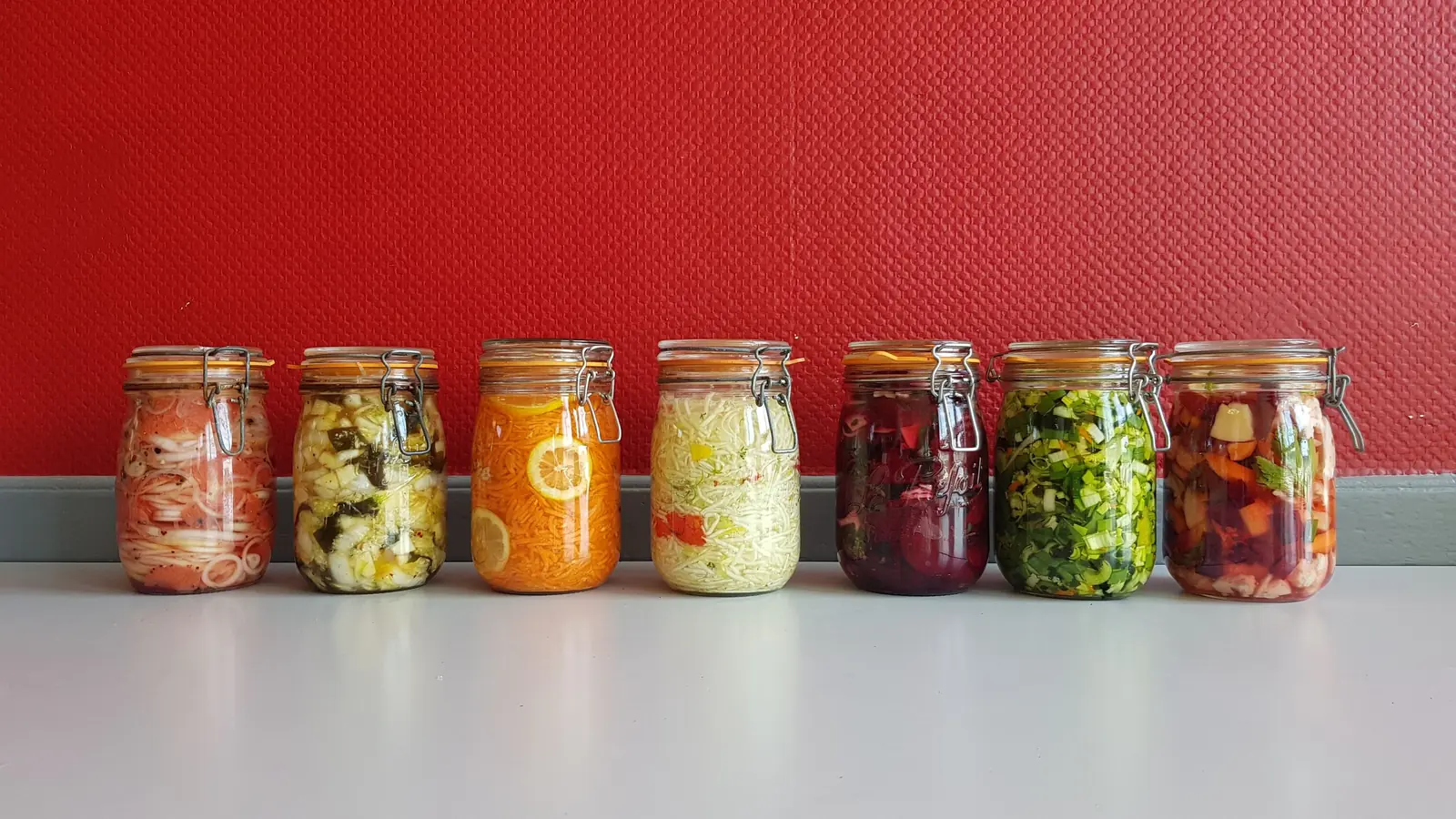
Most of the sauerkraut on grocery shelves is dead. It was fermented, then heated so it could sit at room temperature for a year, and the heat that bought that shelf life killed the very microbes people buy it for. The same quiet swap happens with shelf-stable pickles, most store kimchi, and the "fermented" label on a lot of packaged food. The fermenting happened; the living part did not survive the trip to the aisle.
That gap is the whole game with fermented foods. They can genuinely add living microbes and their byproducts to your gut, or they can be a tangy, pasteurized shadow of that with none of the cultures left. Knowing which jar is which is more useful than any single "eat more fermented foods" headline. Here is how to tell them apart, what the evidence really says, and how to work them into real meals.
The short version
- Fermented does not always mean alive. Fermentation is the process; many fermented foods are heated, baked, or filtered afterward, which removes the live cultures. Look for "raw," "unpasteurized," or "live and active cultures," and find them in the refrigerated case.
- A 2021 Stanford trial is the strongest signal so far. Adults who ate more fermented foods for 10 weeks showed greater gut-microbe diversity and lower levels of several inflammation markers; a high-fiber group did not show the same diversity gain.
- Live-culture foods are not the same as a probiotic supplement. Foods deliver a broad, undefined mix of microbes plus their byproducts; supplements deliver specific, measured strains. Each has its place, and nothing stops you from using both.
- Even "dead" ferments may do something. Sourdough and pasteurized miso lose their live microbes but keep postbiotics, the compounds the microbes made. They are not the headline, but they are not worthless either.
- Start small and feed them. Add one small serving a day and build up; fermented foods can be high in sodium and rough on sensitive guts at first. Pair them with fiber-rich plants, which is the fuel the microbes actually run on.
What "fermented" really means
Fermentation is one of the oldest ways humans kept food edible. Before refrigeration, letting the right microbes grow on cabbage, milk, or soybeans was how you stored a harvest without it rotting. Those microbes eat the sugars and starches in the food and leave behind acids, gases, and aromatic compounds, which is why fermented foods taste sour, fizzy, or funky. That acidity also holds spoilage organisms at bay.
The International Scientific Association for Probiotics and Prebiotics, a panel of microbiologists who set the working definitions in this field, describes fermented foods as foods and drinks made through "desired microbial growth and enzymatic conversions of food components." Two things stand out in that definition. The microbes have to be wanted and managed, not accidental contamination. And nothing in it requires the final product to still contain living microbes, which is exactly where most shopping mistakes happen.
One word these foods get sold on deserves a caveat: "probiotic." Scientists reserve that term for specific microbial strains, identified down to their genetics and shown to benefit health in at least one controlled trial. By that strict definition most fermented foods are not "probiotic" at all; they carry a broad, undefined community of live cultures rather than a single proven strain. That is not a mark against them. It just means "live and active cultures" is the honest label, while "probiotic" belongs to measured supplements and a few well-studied yogurts.
The version most associated with gut health is lacto-fermentation, the route behind sauerkraut, kimchi, traditional pickles, yogurt, and kefir. Lactic acid bacteria, mostly Lactobacillus species and their relatives, convert sugars into lactic acid, which drops the pH, preserves the food, and produces that clean sour tang. Done well and left raw, this kind of ferment carries a dense, living community of microbes into the jar, and from the jar into you.
Which fermented foods actually carry live cultures
This is the part the typical "best fermented foods" list skips. A food earns the "fermented" name from how it was made, but live microbes only survive in the ones that are never heated, baked, or filtered to death after fermenting. Three later steps quietly remove the cultures: pasteurization for shelf stability, baking, and fine filtering. Read the label and check where the product is sold, refrigerated or shelf-stable, before you assume there is anything alive inside.
| Food | Live cultures? | What to know |
|---|---|---|
| Yogurt and kefir | Usually yes | Look for "live and active cultures"; kefir typically carries more strains than yogurt |
| Raw sauerkraut and kimchi | Yes, if refrigerated and unpasteurized | Shelf-stable jars are usually pasteurized and have none left |
| Kombucha | Usually yes | Fermented from sweet tea with a SCOBY (a culture of bacteria and yeast); sold cold, low in microbes, often sugary |
| Miso, raw (unpasteurized) | Yes, if not boiled | Stir into soup off the heat; boiling kills the cultures |
| Tempeh | No (cooked before eating) | A live ferment until it is cooked, which it almost always is; still a high-protein whole-soy food |
| Sourdough bread | No (baked) | Baking kills the microbes; the byproducts (postbiotics) remain |
| Most shelf pickles, wine, beer | No | Vinegar-brined pickles never ferment; wine and beer are filtered |
One label trap is worth calling out. A cucumber pickle made by fermenting in a salt brine is a live food; a cucumber pickle made by pouring hot vinegar over it is not fermented at all, just acidic. They can sit side by side on the same shelf and taste similar. The fermented one lives in the refrigerated section and says "naturally fermented" or "raw," while the vinegar version is shelf-stable and lists vinegar high in its ingredients.
What the research shows
The honest summary is that the evidence is promising and still young. The standout study came out of Stanford in 2021, published in Cell. Researchers put 36 healthy adults on one of two diets for 10 weeks: one group ramped up fermented foods such as yogurt, kefir, kimchi and other fermented vegetables, vegetable brine drinks, and kombucha, while the other group ate a high-fiber diet. The fermented-food group ended the trial with measurably greater diversity in their gut microbes, and the effect grew with larger servings.
The immune side was just as interesting. Levels of 19 inflammation-related proteins in the blood went down in the fermented-food group, including interleukin-6, a marker tied to conditions such as rheumatoid arthritis and type 2 diabetes. The high-fiber group, by contrast, saw no comparable drop in inflammatory markers, and their microbiome diversity held steady rather than rising. The lead researchers called the diversity result a reproducible remodeling of the microbiome from a simple diet change, while being clear that it was a small, short study in healthy people.
A few cautions keep this in perspective. Thirty-six people is a small sample, 10 weeks is a short window, and a result in healthy adults may not carry over to anyone managing a medical condition. The finding does not mean fermented foods treat or prevent any disease, and if you have a gut disorder, it is not a reason to overhaul your diet before talking to your clinician. What it does suggest is that regularly eating live-culture foods is associated with a more diverse gut community and a calmer inflammatory profile, which is a reasonable, low-risk thing to aim for.
This is also where the "dead" ferments earn a mention. Even when the live microbes are gone, fermentation leaves behind postbiotics, the acids and compounds the microbes produced. Early research suggests some of these byproducts may have their own modest benefits, so a slice of real sourdough or a bowl of miso soup is not a wasted effort. It belongs in a different bucket than a raw, living ferment.
Fermented foods or a probiotic supplement?
People often treat these as interchangeable. They are not, and the difference matters. A jar of raw kimchi delivers a broad, undefined community of microbes plus the fiber, vitamins, and postbiotics of the vegetable itself, but you have no idea exactly which strains or how many. A probiotic supplement is the mirror image: a defined set of strains at a measured dose, with no food matrix around it. One gives you variety and a whole-food package; the other gives you precision.
For most healthy people building everyday habits, food is the better default. It is cheaper per serving, harder to overdo, and it brings nutrients a capsule cannot. A supplement makes more sense when you want a specific strain studied for a specific goal, when you are rebuilding after a course of antibiotics, or when live-culture foods are not part of your routine. The two are not rivals. If you eat fermented foods most days and keep a probiotic on hand for the occasional reset, you are covered. Our probiotics and digestive support range is the place to start if you want the supplement route.
How to add fermented foods without upsetting your gut
More is not automatically better on day one. Live-culture foods can cause gas and bloating when a gut that rarely sees them suddenly gets a daily dose, and many are high in sodium. A measured approach gets you the upside without the rough first week.
Start small and build
Begin with a single small serving a day: a few forkfuls of raw kraut, half a cup of kefir, a small bowl of yogurt. Give your system a week or two to adjust, then add a second serving or a second type of food. Spreading different ferments across the week exposes your gut to a wider mix of microbes than leaning on one jar.
Read the label like a skeptic
Buy from the refrigerated case, and look for "raw," "unpasteurized," or "live and active cultures." Skip anything shelf-stable if live microbes are the point, and treat a vinegar-forward ingredient list as a sign the product was pickled, not fermented. For kombucha, scan the sugar grams; some bottles are closer to soda than to a health drink. Two quick tells separate the living from the dead: a genuine live product usually lists its bacterial cultures by name in the ingredients, and a raw, refrigerated ferment often shows faint bubbles in the brine.
Feed the microbes you are adding
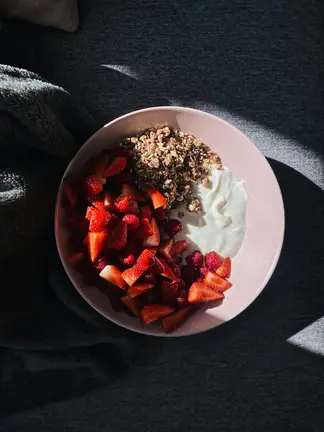
Live cultures need fuel, and that fuel is fiber. Microbes ferment the fiber you cannot digest into short-chain fatty acids such as butyrate, which nourish the cells lining your colon. Pairing fermented foods with fiber-rich plants is the practical version of this: kimchi over a grain bowl, kefir with berries and a spoon of chia or ground flax. Our deeper take on this lives in the guide to the fiber most Americans miss, and the same logic threads through a broader gut-health routine.
Know when to be cautious
Fermented foods are rich in histamine, and people who are short on DAO, the enzyme that clears dietary histamine, can get headaches or flushing from them; most people break it down without trouble. The sodium in kraut and kimchi adds up if you are watching blood pressure. And anyone who is pregnant, immunocompromised, or managing a serious gut condition should run a new fermented-food habit past a healthcare professional first, since not every unpasteurized product suits every situation. This is general information, not medical advice.
A realistic week of live-culture foods
You do not need a fermentation crock or a specialty grocery run. A workable rotation looks like this: kefir or live yogurt with breakfast a few mornings, a forkful of raw sauerkraut or kimchi alongside lunch or dinner, a bottle of kombucha as an afternoon swap for soda once or twice, and miso whisked into a warm broth in the evening. That spread covers dairy and plant ferments, keeps any single sodium source in check, and gives your gut a varied cast of microbes rather than the same one on repeat. The goal is steady exposure, not a perfect daily checklist.
Frequently asked questions
Do fermented foods really improve gut health?
The current evidence is encouraging but limited. The strongest study, a 2021 Stanford trial, found that eating more live-culture fermented foods for 10 weeks was associated with greater gut-microbe diversity and lower inflammation markers in healthy adults. That is a meaningful signal, not proof that fermented foods treat or prevent any disease. They are best seen as a low-risk, helpful habit within an overall varied diet.
Are fermented foods the same as probiotics?
Not in the strict sense. "Probiotic" is a defined term for specific strains, identified at the genetic level and shown to benefit health in a controlled trial. Most fermented foods instead carry a broad, undefined mix of live cultures, so the accurate label is "live and active cultures." They can still benefit your gut, but they are not the same thing as a measured probiotic.
How much fermented food should I eat per day?
There is no official target. In the Stanford trial, benefits grew with larger servings, but participants built up gradually. A practical approach is to start with one small serving a day, watch how you feel, and work toward a couple of servings across different foods. More matters less than consistency and variety.
Are store-bought fermented foods still alive?
Often not. Shelf-stable sauerkraut, kimchi, and pickles are usually pasteurized, which kills the live cultures, and vinegar-brined pickles were never fermented to begin with. Live-culture products are almost always sold refrigerated and labeled "raw," "unpasteurized," or "live and active cultures." If it sat on a warm shelf, assume the microbes are gone.
Are fermented foods or probiotic supplements better?
They do different jobs. Fermented foods deliver a broad, natural mix of microbes plus nutrients and fiber, while supplements deliver specific strains at a measured dose. Food is a strong everyday default; a supplement is useful for a targeted strain or after antibiotics. Many people reasonably use both.
Can fermented foods cause bloating?
They can at first, especially if you add a lot quickly to a gut that is not used to them. Starting with small servings and increasing slowly usually settles this. Fermented foods are also high in histamine and sodium, so people with histamine intolerance or blood-pressure concerns should go easy and check with a clinician if unsure.
The bottom line
Fermented foods are a genuinely worthwhile habit, with one big caveat that most coverage glosses over: the benefit lives in the cultures, and the cultures only survive in the products that were never pasteurized, baked, or filtered after fermenting. Shop the refrigerated case, read for "raw" and "live," and feed those microbes with fiber-rich plants. Do that and you are giving your gut the variety the research points toward, without buying a single thing you do not need.